India’s fashion and advertising industries remain at an early stage of institutional maturity, a condition reflected in their persistent dependence on film celebrities as primary brand ambassadors and runway centre pieces. This reliance suggests a limited differentiation between adjacent creative professions, particularly acting and fashion modelling, which in more established markets are treated as distinct domains with specialised forms of expertise.
In mature fashion ecosystems such as those in the Europe or the US, it would be unusual to see mainstream film actors routinely occupying roles traditionally reserved for professional models, whether in television advertising campaigns or as showstoppers at fashion weeks. Cultural figures like Jack Nicholson endorsing fast‑food brands, or actors such as Charlize Theron or Gwyneth Paltrow repeatedly headlining designer runway shows, would likely be perceived as misaligned and incongruous with industry norms. These roles are instead traditionally reserved for career models, such as Gigi Hadid and Kate Moss.
A one-off luxury perfume campaign or a high-end car advert featuring a film star is understandable as it trades on a closed loop of aspiration and image, hence can be justified. But Pan Parag is something else entirely. Its fortunes are built on widespread consumption and mass addiction among the lower strata, with their health as collateral, only so those proceeds can be funnelled upward to pay obscene endorsement fees to the very elites who would never touch the product themselves. It’s not image-building; it’s exploitation with a celebrity smile. The poor in India cannot discern between an endorsement and the reality. They have built a temple for Khushboo Mata in the South. She is an actor for heaven’s sake.
The Indian fashion ramp is frequently ceded to film celebrities, even when highly trained professional models are present and relegated to the background. When an actor such as Janhvi Kapoor headlines a show while accomplished runway models follow, it raises a larger question about professional boundaries and respect for craft. Modelling, like acting, is a discipline in its own right. Until the industry allows each profession its due space, Indian fashion will continue to struggle for global credibility.
Ah those days of Milind Soman. And Mehr Jessia. Now imagine Raj Kapoor in a Pantaloon ad. 😊
Lately, my feeds have been flooded with videos from Hollywood and Bollywood celebrity events. I recognise perhaps five per cent of the people featured. I can barely tell the Met Gala apart from the Oscars, the BRIT Awards, the Grammys, Cannes, or whichever city happens to be hosting the spectacle that week. Most of these events blur into one another: the same visual grammar, the same manufactured themes, the same performative excess.
The formula is familiar. Women in deliberately outrageous outfits, escorted by men who appear either aggressively anonymous or carefully stylised into blandness. Competitive ostentation is everywhere, each appearance striving to outdo the last. At times, it is difficult to discern whether some of the most visible figures even have a substantive connection to cinema, fashion, or the arts.
Take Nita Ambani, for instance, who seems omnipresent, now often accompanied by her daughter, who’s adorned head to toe in gold and precious stones, jewels that can re-embellish the Somnath temple, but alas, it’s Nitaben’s. One is left wondering what role this spectacle plays within film or fashion culture. Even better question would be: what would they be without the excess? The proximity to global pop stars adds another layer of surrealism, with the same handful of social figures recurring endlessly, often without any clear creative contribution.
In India, particularly, a striking sameness has emerged among new entrants to the spotlight. Faces appear increasingly interchangeable, as though shaped by the same cosmetic templates: identical lips, cheeks, bodies, and noses; the same aesthetic priorities; the same stylists and make-up artists, the same “fair” complexion, often bleaching individuality into uniformity. Even clothing seems governed by a single philosophy that equates minimal fabric with maximal impact.
What is most revealing is the choreography itself. Poses are not accidental; garments adjusted to ensure exposure of flesh is precisely calibrated. I have watched this happen, where the women ensure their cleavage, and sometimes other things, is not (heaven’s forbid) “accidentally” covered. It feels curiously inverted from earlier notions of elegance or restraint, or perhaps from what these events once claimed to celebrate. What remains is not art or glamour, but repetition: spectacle emptied of meaning, endlessly recycled for attention.
To think of it, a few years ago, when every Indian (celebrity or not) was wearing a western gown, I felt good about embracing my good old sarees. The attire stood out, until everyone chased the saree, and made it look like a saree-lookalike: a backless, waist less, armless, neckless, nauseatingly sequined cabaret outfit. Thankfully, the real saree wearers still look elegant.
I used to enjoy the awards shows, but now I cannot sit through them, as they lean heavily towards vulgarity, grand titles and self‑mythologising drama, orchestrated rather than organic.
IIFA and similar shows often trade in spectacle with exaggerated epithets as shorthand for star power rather than literal claims. SRK’s “King Khan” label is height of embarrassment. He seems to be shamelessly rejoicing in that glory, when being lowered from the sky, akin to Vishnu Avtar, amongst the sad, mere mortals, who are made to look completely hopeless and talentless in the presence of God. I find it vulgar, and hard to watch, when in company of my family, who are still not familiar with the classic Indian sycophantic mentality.
I’m not a big fan of anyone as such, but the celebrity status of Bachchan, even if really grand, was much more tolerable. There was flamboyance, but with subtlety.
Lately, the news has been focusing on Epstein. The fact is, the Epsteins of the world do not work in isolation. They have support of other people, men, and oftentimes, women, either in their own families, or in their circle of friends, who have a lot in common with such individuals, either in deed, or in attitude, or in gene, or in mentality.
This problem is more common than we care to believe or admit.
Grooming, trafficking and abuse of young victims are widespread. A new show on TV, “Hush Hush” was quite disturbing towards the end of Season One. The story took a turn towards child trafficking in an orphanage. It often is seen happening in places or situations where young people are at their most vulnerable, including in families. In fact, it’s usually within the families that the vulnerable drop their guards. These victims usually have no solid family unit or support (such as when parents have divorced, or step families take all the attention) and tend to become easy targets for such individuals who enjoy playing the power game. These individuals have mastered the art of grooming. They confidently know that those around them will “Hush Hush”, while the victims will be too shaken, broken, disturbed, afraid or ashamed to speak. Because that’s what they are made to believe, that it was all “their fault”.
Such victims have often been left in care of other adults who are known to them, seemingly “decent” “respected” individuals. These adults, who come in all shapes, sizes and backgrounds, exploit the opportunity presented to them, especially because they don’t overtly fall under “suspect” spectrum, and are from seemingly “decent” families/environment.
Exploitation of the vulnerable (sexually, domestically, verbally, emotionally, physically, mentally) is far more widespread than previously acknowledged. Amazingly enough, sometimes, people from loving and stable homes, educated and smart, can also fall prey to such abuse, as they have had no reason to believe why people would be bad or abusive. They have had no such experience before, so it comes as a surprise and a late realisation.
S and L’s families were part of the discussion on the news today. L’s mother talked about “the man” who had a history of indecent exposure, which gradually grew into something bigger that led him to do (it’s so horrific that I shake writing about it) what he did to her daughter. She made an interesting, but poignant (considering what happened to these innocent girls) point about both these men (who were responsible for S and L), and that is, that in cases where someone who has had a history of indecent exposure (as that’s how they start) incrementally results into something much more sexually horrific and also dangerous. This reminded me of a minor victim’s case who had a similar story to tell.
The change we are seeing in today’s world is amazing. New laws against such crimes are being introduced. More avenues for victim support being launched. Victims speaking up against their abuse. Criminals being tried after 20, 30, 40, or even 50 years. Some posthumously shamed. Those times are long gone when bad people thought they can do bad things and get away.
It’s only a matter of time when it will catch up with those who thought they had gotten away too long for it to ever become an issue. It catches up with the accomplices too, who often walk around in the society, acting high and virtuous.
This is a reflection of their character. Wherever they find an opportunity to exert their power, they do it without a thought for the consequences on their victims. Their selfishness and their desire to derive sadistic pleasure by inflicting pain on the vulnerable is so overwhelming that they engage in such acts just to gloat in the suffering of their victims to fulfill their sadistic purpose.
These filthy people are the self-proclaimed messiahs of the society. They are often heard talking about their greatness and how they have saved (read destroyed) people’s lives.
Those who are the most unscrupulous, blow the “scruples” trumpet the loudest. Probably as an attempt to ward off the attention on the critical agenda. These individuals employ the policy: shout really loud to supress victims’ cries. They attack, as they believe that’s the best form of defense. Don’t give anyone a chance to speak. They train their brain to divert all the attention and blame on someone else. It never matters on whom. Those who do not fit in their “circle of influence” can easily be dispensed with. They speak a unified language that does not include words like “value”, “life”, “reasoning”, “wrong”. Anyone they can conveniently do a crime against, they will do it, because they believe they’ve played their cards really smart by hoodwinking their way into undeservedly favourable position. They never want to take the blame for anything. It’s always the fault of someone else for giving them the power and control, hence they cannot handle, but they will never relinquish either. They constantly blame others for everything, like some sort of sinister power game they have been forced to get addicted to. Some sexual abusers actually use that as an excuse. Thankfully, the criminal justice system does not buy that excuse.
Such crimes find a way to surface. Or, in Vic’s words: The sword of Damocles forever hangs over their heads.
Such people are afraid of women feeling empowered. One can only imagine why! But, I’d say, more strength and power to these victims. Time to speak up for those who need support.
Over the years, I’ve photographed almost every famous street in London, but a great number of photos in my collection are of the West End where stage shows are known to run for a long time, sometimes decades. So, one might see the same theatre-billboards in my photos spanning over many years, then one day it will have changed. At Prince Edward’s, I’ve seen only three changes in 12 years, JerseyBoys to Miss Saigon, and then Aladdin. (I heard Mary Poppins is running currently, but I’ve not photographed the theatre in recent months).
Westerners (especially the young), when asked about Aladdin, claim to know who he is/was – a Disney character, obviously. They are right. He is a Disney character. But not to us Easterners.
We grew up reading Aladin ka Chirag and Aladin aur Genie, or the Forty Thieves, as part of our intra-and-extra curricula. Every household had Arabian Nights literature. In school, one year we would have essays on a portion of the One Thousand and OneNights, while another year we will spend on comprehensive study of Dickens’ David Copperfield. Even Don Quixote and Sancho Panza were sketched in our books and exhaustively analysed, down to Quixote’s horse’s hooves. It was as if reading the books was not enough, our young minds had to find the answers to all the whos, whys, whats, wheres, hows, and even whynots. I’m not even going to touch upon the topic of poetry, because if someone read my blog, they would scracely believe that we learnt every single poem by heart, as a stanza from anywhere from those 30 to 40 poems learnt each year could be asked in the exam. Literally, like this…
Q1. Write the title of the poem, the poet’s name, and complete the following stanzas…
One shade………… innocent!
Q2. Read the above poem and explain who, what, where, how, why and whynot.
(I’m pretty sure that Keats and Byron scholars made things up as they went along… to cause us frustration). (Okay, I did touch upon the topic already). And, why do people celebrate Shakespearean English that much but not speak in that?
Even so, despite the lengthy syllabus and ongoing frustration of coming up with gobbledygook explanations, English Literature and English Grammar (yes, that’s right. Grammar was a standalone topic) were my most favourite subjects, followed closely by Geography. Hindi was fairly easy too. Sanskrit was fun as we can show-off a bit, by reciting the ślokas to the non-learned. I never understood why I had to learn anything else. I suppose it was to help our kids one day with their school work. And, Maths! Where is that boy, Aryabhata? Bring him to me!! I’ll sort him out.
So, coming back to Aladdin…
I came across this photo of mine from one of the street adventures and was transported back to my younger days of The Arabian Nights nights, surrounded by many books, some with illustrations, while some without, in which case we imagined the magical scenes and the flying rugs. I had mastered the drawings of Genie and the magic lamp. I owned a similar brass lamp from Rajasthan (I’ve often compared things between Arabia and Rajasthan – desert, climate, camels, jewellery, cooking vessels, musical instruments, and also the music). Once or twice, I tried rubbing my brass lamp to summon the Genie, but a giant cockroach appeared instead from under the door, let in by my brother, who expertly disturbed my concentration. In retaliation, I would catch a lizard from the adjoining tree and let loose on him.
My room had a beautiful rug and my mind had the capacity to imagine beautiful things. I read somewhere that if I could learn the magic words in Arabic, I could make my rug fly, with me seated on it. So, I started to leave my verandah door open before uttering the magic words (in case the rug wooshed and started banging against the glass – I might have had a “crash” landing). But the rug never left the earth. It probably could not comprehend my rustic Arabic. The accent was too Hindi. I knew I had to brush-up my Arabic.
At the university, I had several Middle-Eastern friends. I tried to learn a little Arabic from them, but they were more keen to learn English from me. They did not crave the rug flight as much as I did. They probably had quite a few around-the-globe already, then hopped off on India.
One day…I’ll summon the jinni and get him to arrange a flight for me. And since I’ve waited so long, a detour would be appreciated. Moon maybe!
P. S. I never understood this… Genie is meant to be an imprisoned slave, a good guy in the Nights, then why do we in the East use the word ‘jinn’ as having negative connotation of evil, devil or unpleasant or monstrous spirit, a shaitan?
Whys for another time! For now, I’ll curl-up in bed and dream of flying and enjoying a bird’s-eye view of the planet. It’s an interesting way to put all things into perspective. My little worries won’t mean much from above. I’ll be just a speck, and my worries even smaller. Thank you, Aurelius.
Summers are hot in India. As hot as hot gets. We left England to go to India right in the middle of Indian summer. One afternoon, Manjula invited us to meet her family that included a buffalo and a calf. The entire village turned up seeing our car parked outside Manjula’s house. There were many children, young men and women, some elders and a shaman. The shaman was squatted on the floor holding a bouquet of peacock feathers. He spoke little, but enticingly. I have never believed in shamanism, astrology or black magic, but he convinced us that we must have our stars looked at (he said forehead, as in India they believe that future is “printed” on your forehead)
So, I gave in… I was given a chair while he continued to be seated (squatting) on the ground. He recited (mumbled) some mantras. At one point, I burst out laughing but I sensed his annoyance at my ignorance (read frivolity). So I shut my mouth and observed. Even started to enjoy as he started touching and tapping the peacock feathers all over me and I felt tickled and relaxed. I didn’t want him to stop. Five minutes later, he stopped and said, “it’s fine now.” He was so reserved as a person that I didn’t want to question him (due to fear of annoying him, a shaman, in case he gets angry and I’m subjected to his wrath (curse)), “what was fine? Was it not fine before?” I left those questions for my mind to deal with. I simply thanked him and moved aside.
Then he turned towards Deepak and told him that he needed a mantra “treatment” too as something was “picked up” that needed warding off. Deepak, superstitiously, sat down for the cleansing ritual immediately, partly not wanting to take any chances, and partly out of respect for the old medicine man who might have been doing this to make some money, but the village folk were convinced the old “doctor” had supreme powers. Perhaps he did. Perhaps he did ward some evil influences off us. After the same feather-touching ritual, tickly and giggly massage, Deepak paid the guy for the two of us. The old guy looked very pleased and blessed us all. I believe his blessings really helped.
As if every visitor had to go through the cleansing custom before being allowed into the village, we were taken through the alley that led to Manjula’s house. We were shown every single room, kitchen, cattle and their tabelas, and also the street dogs that had conveniently made the place their permanent home.
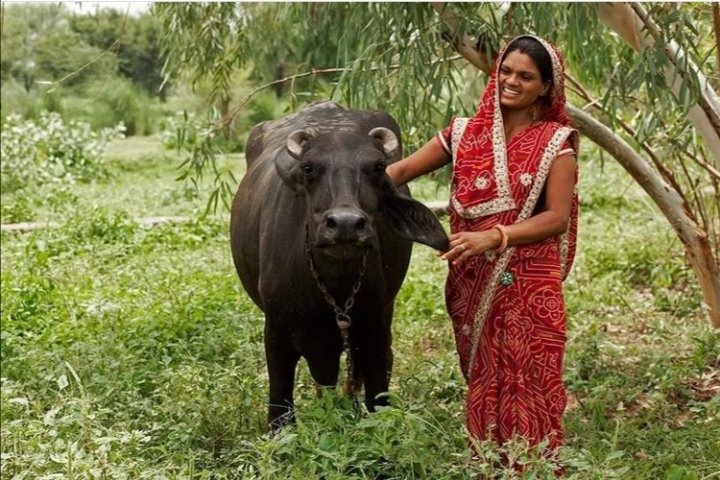
Chandni, the fully-grown female buffalo came running towards Manjula. “She’s thirsty,” said Manjula, to explain Chandni’s slapdash. Chandni was given a bucket-full of water. She played with the petite Manjula and continued to dance – this time she was entertaining the guests with her performance.
After the theatrics, she posed for my camera like a true star.
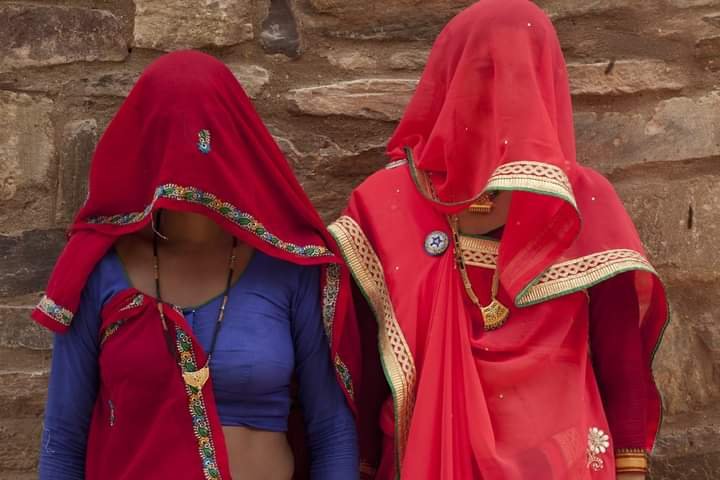
Seeing women walk the streets with their heads covered with a brightly – coloured sari pallo is a sight I’m ever so used to. And yet, I was sold into the fuss of the hijab in the West until a friend noticed my photos from Rajasthan and enquired whether Rajasthani women wore veils too, like the Muslims. Veils? Of course, that’s what it looks like! That’s when it struck me how Westerners, who are not familiar with the Eastern customs, perceive a ghoongat.
Ghoongat ‘is’ a veil, but not a hijab. Ghoongat is worn only to cover the face in front of family male elders, or elderly visitors, but not strangers. Head is incidentally covered as there is no other way to bring the sari on the face. (Head-covering is a custom many religions around the world observe during religious practices, and hence not unique to Hindus)
Coming back to the ghoongat, it is not as long or as dark-coloured as a hijab or burkha; it is mostly made from a colourful semi-transparent material; and only reaches either below the nose, exposing the lower face (lips, chin and neck), or barely below the face, leaving the neck exposed, while the face is faintly visible too through the chiffony material. Funnily, some women who wear the ghoongat have their cleavages or bosoms revealed with no sari draped over the blouse, making the subject far more conspicuous instead of doing the opposite. I personally think it’s a statement of sexiness.
When I photographed these women, my foreign-born sister-in-law was with me, and curious to know why one lady was more covered than the other. I knew the answer instantly – the older woman, with less covering, exposed bust, was the mother-in-law of the newly-wed younger one who was fully convered out of respect for the elders in the community who were around when we met them. My sister-in-law responded, “It’s totally the wrong way around. Younger woman should reveal more, while the older should remain covered.” 😂 Made complete sense. But the young one was preserved, so to speak, for her new husband.
Well, on old or on young, the ghoongat covers much less than it reveals. A ghoongat might be a veil as a hijab is, but the distinction between the two remains stark.
In a separate discussion on cultural nuances….
There was an incident in the US where a female employee of Indian origin walked into her corporate office wearing a sari, but was asked by the employer to not repeat that attire in the office as it reveals too much flesh (waist, back, neck and arms) and deemed “overly sexy” (the word ‘sexy’ was actually used). Strange, because in India we consider sari a conservative piece of clothing, while a skirt not so much, as it reveals legs. In some cultures, it’s okay to wear work suits that keep your legs uncovered, but wearing clothes that reveal the upper body flesh would be considered inappropriate. On the other hand in India, a country that’s labelled conservative (by western standards), though the legs remain mostly covered (not prohibited, thankfully), flaunting of cleavage and waist is permitted, because that’s exactly what a sari does, and yet it’s considered a conservative attire and broadly worn by professional women. Ah, so fascinating to observe these cultural differences; and difference in understanding and perspectives.
Over the years, and even before I declared myself a photographer, I photographed several towns, districts, tribes, people and their homes running along and across the Aravalli mountains. I’ve been driven along the fold mountains ever since I was born, either to reach our ancestral home, or that of our relatives, and now my parents’ and brother’s. In recent years, my brother, Deepak, has driven me around hundreds of miles, through villages and tribal areas that made for a fascinating experience. Because of his extensive travel experience and knowledge of the areas and communities, he’s fully familiar with the places I will find interesting, as a photographer. His good connections in the land have proven useful too, to get access to no-go zones. People who would normally not entertain you, happily welcome you, because there is a common language and understanding once we have had a chance to connect.
This day was one such experience. We drove far from Jaipur and reached a town habited by the Gurjars (aka Gujjars). There was a tense environment upon approach. Gurjars have been, until recently, a lot in the news because of rioting, killings, disruption. They are a feared tribe of the North. Their men are tall, physically strong, fierce and rough in approach, proud but with a patriarchal mindset. They are known for charging before speaking. They own swords and carry knives hidden in their clothing. That’s what I’m told. Basically speaking, you cannot afford to be a gurjar’s enemy in those regions. I sort of worried thinking what might happen. They had rioted on the highway only a few days before we went there.
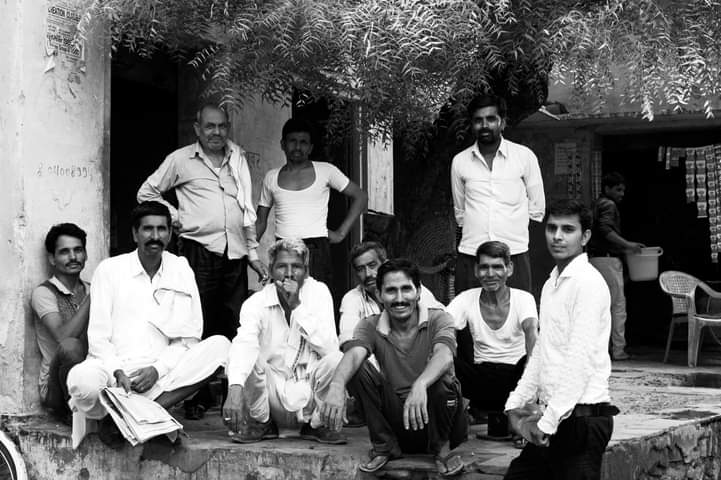
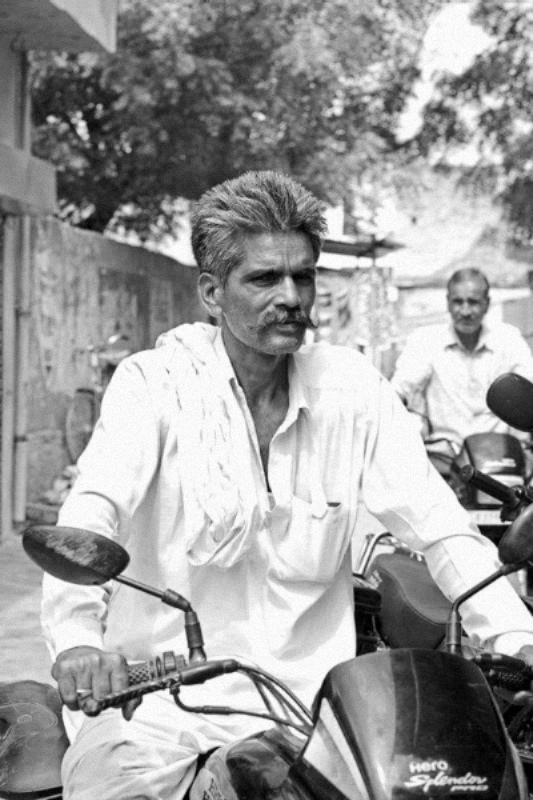
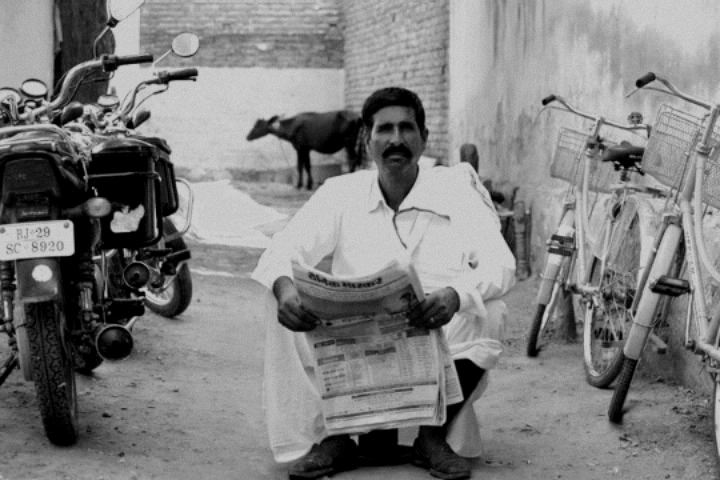
So, here we were, myself and Deepak, entering this village. We got off at the square where many heavy-built men with sun-kissed ruggedness and long moustaches were seated on their Enfields and Hero Hondas, or on a raised chabutara. Two of them got up with their sticks to enquire the purpose of our visit. Deepak got out of the car to speak to them. After a few minutes, he returned and asked me to step out of the car and enter the village. “No holds barred. You have a free rein,” he says. That I can do what I like, enter any home I like, speak to any man, woman, child, elderly, take photos of their homes, people and cattle. This came as a blessing for me.
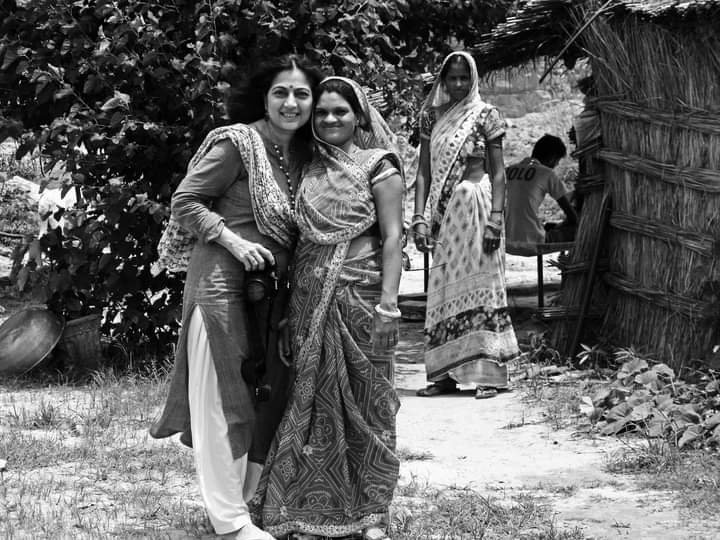
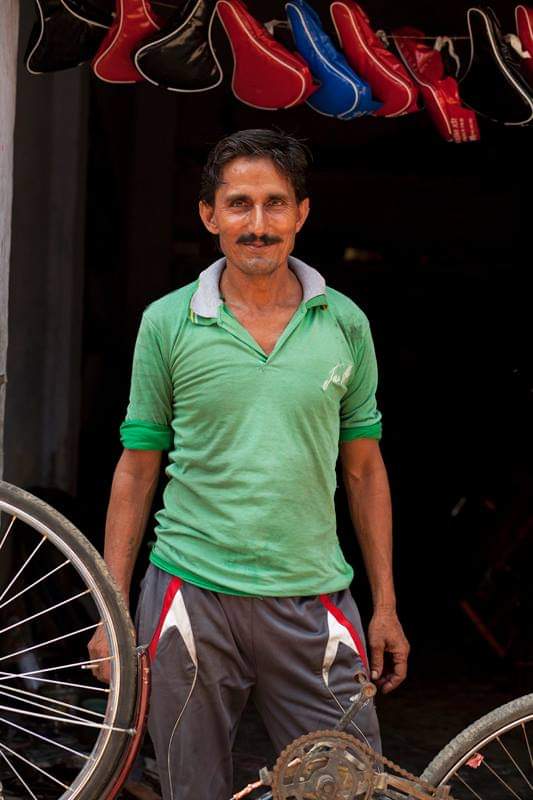
They did, though, kept asking in various ways if I was a journalist. It took me three hours to convince them fully that I was one of them, a Rajasthani, and not there to cause any trouble. That the photographs were for personal use, not commissioned by any publication, that what they share with me will remain with me. No one will find out. I had no qualms about sharing my details with them, just to put their minds at rest. I spent the day chatting with and photographing the tough guys as Deepak patiently waited at the square with the even tougher ones. One sweet young fellow in green, with green eyes too, invited me to his cycle shop. If he’d ever walked on London or LA streets, people would have mistaken him for Kirk Douglas. By god, that resemblance was uncanny.
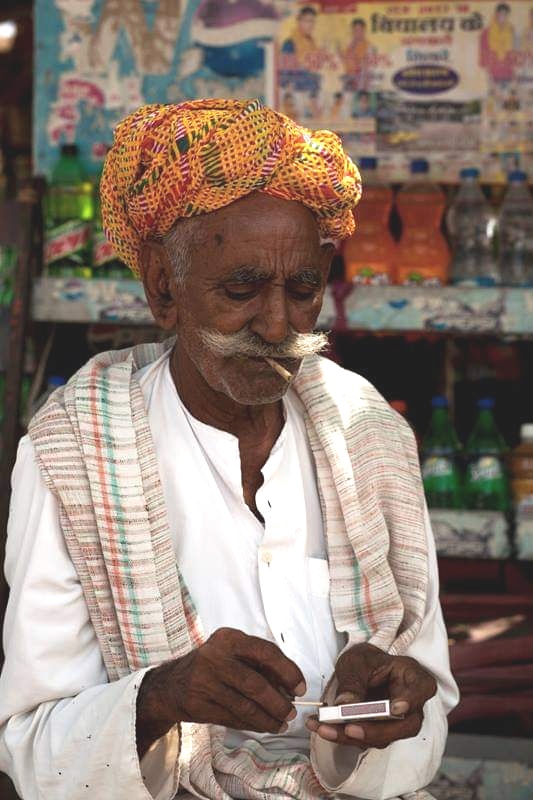
The toughest nut to crack was the head of the Gurjars. The old man, who Deepak addressed as tau. They had met a few times before, as Deepak had passed through the town a number of times, but never had he sought permission to allow a stranger (me) into their lives. It was the first. Once cracked, tau took me to a few homes himself. Nobody could turn him away. That’s the kind of authority he wielded among the village folk. Deepak waved at me and said, “Now that he’s happy with you, you are set.” I was actually set. That’s when I got to mingle with the toughest lot. The stories they shared will remain with me forever. They got their women to offer us tea and snacks. They preferred I didn’t share photos of their women, but allowed me to photograph them. I appreciate and respect their trust in me.
It was the most gratifying journey, thanks to Deepak who made it all possible for me. Thanks to the Gurjars who welcomed me in their homes and lives, shared stories that changed my perception of them. People might continue to fear them, but they promised me that I can visit anytime I like, give any one of them a call, and they will be there to welcome me.
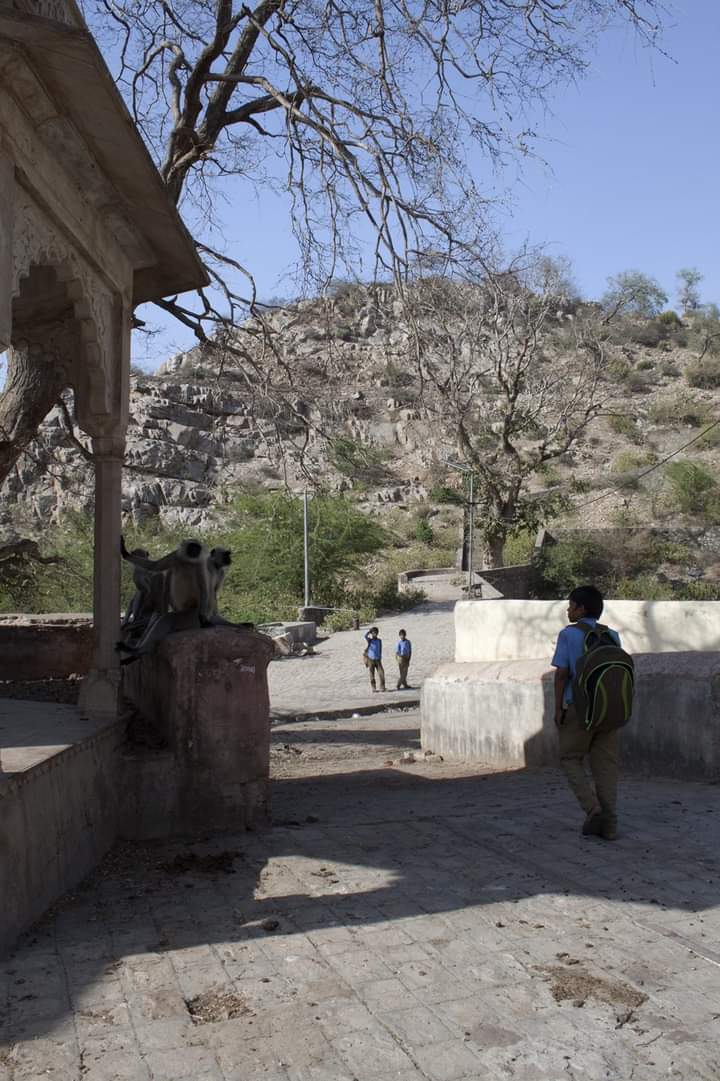
It’s rare not to find a langur army in and around Jaipur fortresses, palaces, lakes and Aravalli foothills.
This photo was taken on a hot summer day. A hot summer day in the desert state is not the kind of heat most people are accustomed to elsewhere. Those who are not accustomed to such temperatures should not venture out here during daytime.
A school bell (the old school bell, literally) had just rung and the school kids carrying huge backpacks poured out in their hundreds, but quickly dispersed. Many, forming small groups, went towards the hillock, climbed the snaky rugged path before disappearing into a distance. I had no idea where their homes were, but I could only guess they must be behind that mound. When seen carefully in the photo, one can see some kids walking in a distance on the hillock.
Although, I’ve studied in India, and am used to the concept of carrying huge school satchel bags (as we didn’t have backpacks in those days, only traditional satchel bags), but I’m increasingly noticing the weight Indian kids carry to school and back daily. Why do such small kids need so many books everyday? Well, I kind of understand as we needed them too, but I can’t help but feel sorry for the kids.
The nice thing for these kids was the company of langurs on their way. A daily ritual for them, but they seemed to still enjoy as much as I did. I stood there for some time to observe how they took turns to run past the monkeys. Black-faced langurs are not known to be dangerous. They are only disruptive, especially when they enter homes. They can open your fridge, grab what they want, eat, drop, make a mess, eat your plants in the garden, break things before they exit.
But these kids still exercised caution. The kids who managed to cross first will wait for the rest of the group members to join. The funniest thing I noticed was how the ones who made it to the other side would shout and cheer the remaining ones, “Come on, you’re brave, langur won’t do anything. Hanumanji hain! (he’s only Lord Hanuman – meaning “Gods don’t harm”). Such words of encouragement. Emboldened, they all make it past the monkeys.
They will do the same thing all over again tomorrow. The monkeys will again wait to grunt at the kids. To scare them. It must be a kind of game they all play together. I think they understand each other well. Thinking this, I exit too, without leaving a mess though.
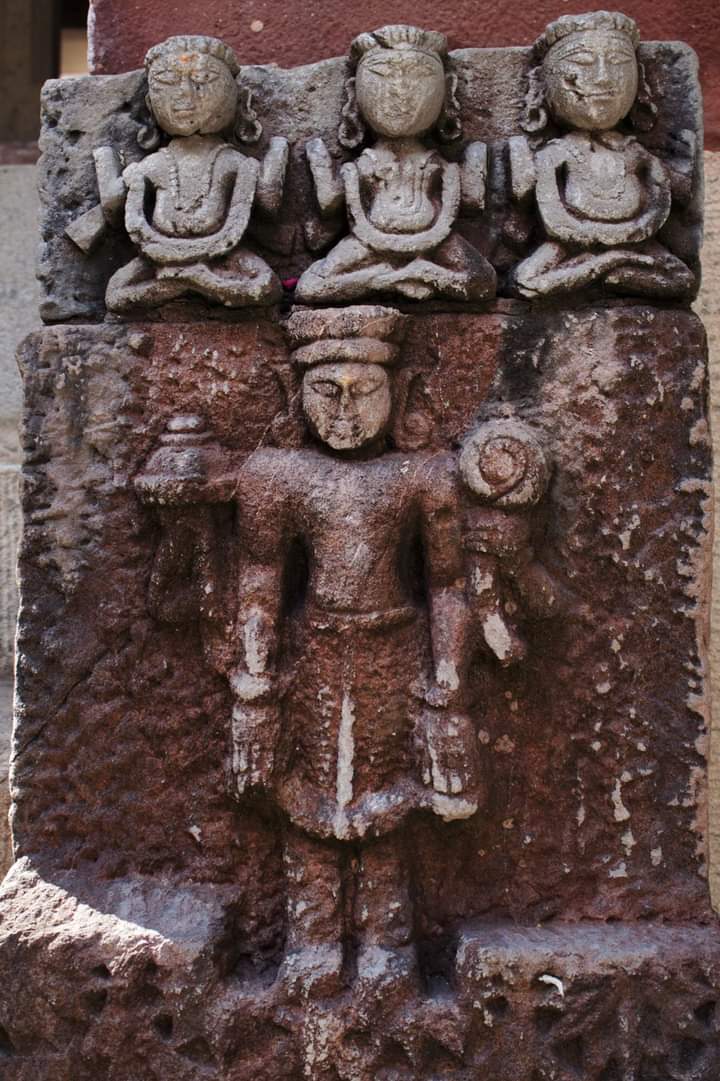
This stone statue was in a small 500-year old temple in Amer. I first thought that the three seated on top formed the trimurti, the Hindu trinity. Upon close inspection I realised that the main standing statue is of Lord Vishnu, who happens to be one of the three supreme gods of the trimurti. And those seated above Vishnu cannot be identified as the trimurti. They are dressed more like sages than like Gods, who are figures of ostentation, except for Lord Shiva, who appears handsomely powerful even when seated half-naked. And his hair is beautifully top-knotted with Ganga flowing out of his curly hair-locks. He would never sit docile like a sage. And then, these are three.
So, who are they? Could one of them be Narad muni? But he originates from Vishnu’s navel. Let’s say the connecting piece fell off during the move. What about the other two figures then?
Or are they not even part of the main statue? Two separate stone carvings placed together, like in most places where ancient temples and palaces are in a state of disrepair and neglect, and stones weathering at different rates.
Could this explain the difference in colour of these two pieces?
Whatever maybe the case, it’s a beautiful piece that’s survived half a millennium, and probably would last another half.