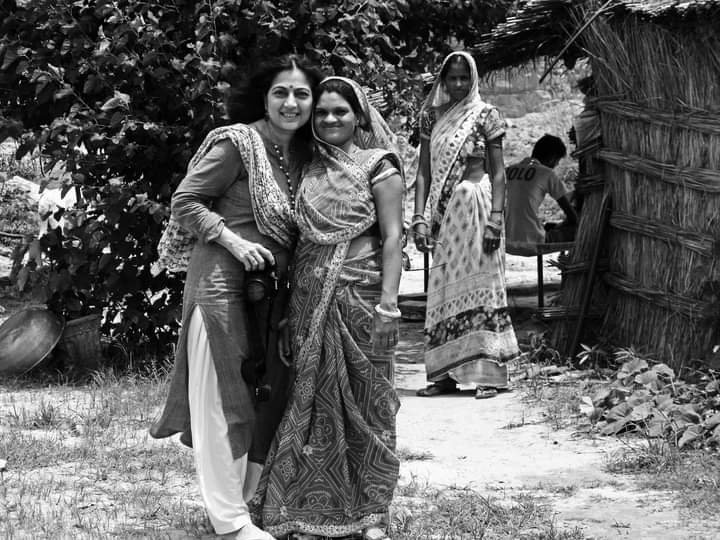
Visiting Manjula’s Village

Summers are hot in India. As hot as hot gets. We left England to go to India right in the middle of Indian summer. One afternoon, Manjula invited us to meet her family that included a buffalo and a calf. The entire village turned up seeing our car parked outside Manjula’s house. There were many children, young men and women, some elders and a shaman. The shaman was squatted on the floor holding a bouquet of peacock feathers. He spoke little, but enticingly. I have never believed in shamanism, astrology or black magic, but he convinced us that we must have our stars looked at (he said forehead, as in India they believe that future is “printed” on your forehead)

So, I gave in… I was given a chair while he continued to be seated (squatting) on the ground. He recited (mumbled) some mantras. At one point, I burst out laughing but I sensed his annoyance at my ignorance (read frivolity). So I shut my mouth and observed. Even started to enjoy as he started touching and tapping the peacock feathers all over me and I felt tickled and relaxed. I didn’t want him to stop. Five minutes later, he stopped and said, “it’s fine now.” He was so reserved as a person that I didn’t want to question him (due to fear of annoying him, a shaman, in case he gets angry and I’m subjected to his wrath (curse)), “what was fine? Was it not fine before?” I left those questions for my mind to deal with. I simply thanked him and moved aside.

Then he turned towards Deepak and told him that he needed a mantra “treatment” too as something was “picked up” that needed warding off. Deepak, superstitiously, sat down for the cleansing ritual immediately, partly not wanting to take any chances, and partly out of respect for the old medicine man who might have been doing this to make some money, but the village folk were convinced the old “doctor” had supreme powers. Perhaps he did. Perhaps he did ward some evil influences off us. After the same feather-touching ritual, tickly and giggly massage, Deepak paid the guy for the two of us. The old guy looked very pleased and blessed us all. I believe his blessings really helped.

As if every visitor had to go through the cleansing custom before being allowed into the village, we were taken through the alley that led to Manjula’s house. We were shown every single room, kitchen, cattle and their tabelas, and also the street dogs that had conveniently made the place their permanent home.

Chandni, the fully-grown female buffalo came running towards Manjula. “She’s thirsty,” said Manjula, to explain Chandni’s slapdash. Chandni was given a bucket-full of water. She played with the petite Manjula and continued to dance – this time she was entertaining the guests with her performance.
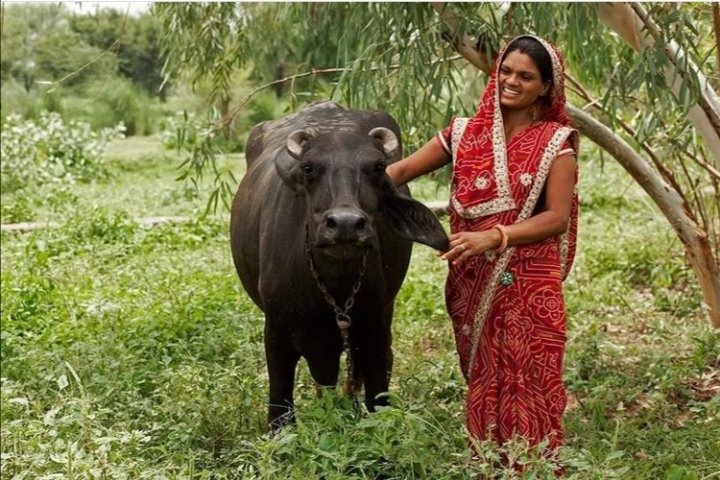
After the theatrics, she posed for my camera like a true star.
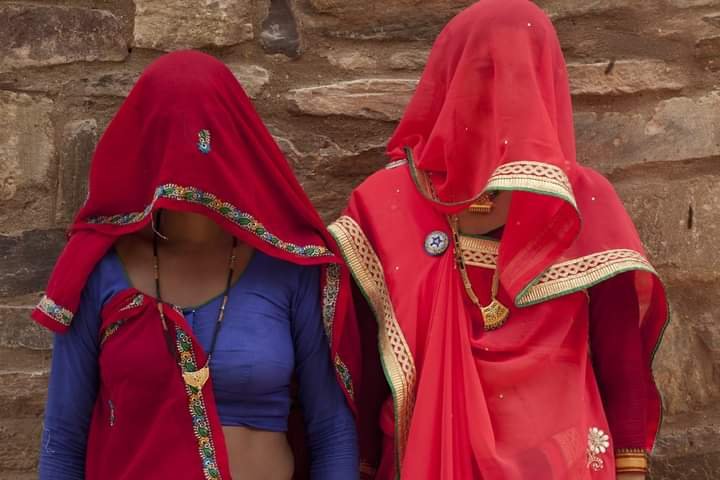
Ghoongat – Statement of Sexiness

Seeing women walk the streets with their heads covered with a brightly – coloured sari pallo is a sight I’m ever so used to. And yet, I was sold into the fuss of the hijab in the West until a friend noticed my photos from Rajasthan and enquired whether Rajasthani women wore veils too, like the Muslims. Veils? Of course, that’s what it looks like! That’s when it struck me how Westerners, who are not familiar with the Eastern customs, perceive a ghoongat.

Ghoongat ‘is’ a veil, but not a hijab. Ghoongat is worn only to cover the face in front of family male elders, or elderly visitors, but not strangers. Head is incidentally covered as there is no other way to bring the sari on the face. (Head-covering is a custom many religions around the world observe during religious practices, and hence not unique to Hindus)

Coming back to the ghoongat, it is not as long or as dark-coloured as a hijab or burkha; it is mostly made from a colourful semi-transparent material; and only reaches either below the nose, exposing the lower face (lips, chin and neck), or barely below the face, leaving the neck exposed, while the face is faintly visible too through the chiffony material. Funnily, some women who wear the ghoongat have their cleavages or bosoms revealed with no sari draped over the blouse, making the subject far more conspicuous instead of doing the opposite. I personally think it’s a statement of sexiness. 

When I photographed these women, my foreign-born sister-in-law was with me, and curious to know why one lady was more covered than the other. I knew the answer instantly – the older woman, with less covering, exposed bust, was the mother-in-law of the newly-wed younger one who was fully convered out of respect for the elders in the community who were around when we met them. My sister-in-law responded, “It’s totally the wrong way around. Younger woman should reveal more, while the older should remain covered.” 😂 Made complete sense. But the young one was preserved, so to speak, for her new husband.

Well, on old or on young, the ghoongat covers much less than it reveals. A ghoongat might be a veil as a hijab is, but the distinction between the two remains stark. 

In a separate discussion on cultural nuances….

There was an incident in the US where a female employee of Indian origin walked into her corporate office wearing a sari, but was asked by the employer to not repeat that attire in the office as it reveals too much flesh (waist, back, neck and arms) and deemed “overly sexy” (the word ‘sexy’ was actually used). Strange, because in India we consider sari a conservative piece of clothing, while a skirt not so much, as it reveals legs. In some cultures, it’s okay to wear work suits that keep your legs uncovered, but wearing clothes that reveal the upper body flesh would be considered inappropriate. On the other hand in India, a country that’s labelled conservative (by western standards), though the legs remain mostly covered (not prohibited, thankfully), flaunting of cleavage and waist is permitted, because that’s exactly what a sari does, and yet it’s considered a conservative attire and broadly worn by professional women. Ah, so fascinating to observe these cultural differences; and difference in understanding and perspectives.