Svástika – A divine and spiritual symbol in Hindusim
I am born into a Hindu Brahmin family in India. This statement alone equals to passport to respect, social privileges, and positive discrimination for life. Every single application form asks for your caste and I wrote ‘Brahmin’, unbeknownst to me at the time its importance in terms of being accepted in whatever it was I was wanting to choose as long as I had the right credentials.
So, why in the world would I even want to highlight the wrongs of the millennia-old system, – ‘The Caste System of India’?
The answer is – my conscience does not allow me to continue without questioning.
This world; its system, environment and abundance should also belong to someone else as much as they do to me.
Same as I am opposed to monarchy, which represents all that meritocracy does not, I am vocal about casteism as this too advocates the by-birth rights, undermining the efforts and struggles of those from the ever-growing educated class, some of whom were not born into the upper strata of the caste hierarchy, but qualify only through the constitutional concessions, in spite of having the right credentials. Funnily, this new breed became a target of mockery – ‘educational success because of concessions’.
How can an upper caste person’s access to privileges not be labelled as a concession instead of a prerogative?
So, in some way, both sides of the caste-scale fall under constitutional concessions. One side has all set. The other, not so. If the caste-scale transformed into a caste-balance, it will tip to one side. The more the weight of privileges, the lighter it becomes. Oppositely, the burden of inequality is heavier, which means those on that side will forever struggle to tip the balance in their favour.
Will it ever happen? I doubt it would in my lifetime, for there is a life beyond the educational system. The upper-caste mafia rules the roost in every region, department, field, discipline, branch, sector, and so on. For some have-nots, it is a grim situation of one-step-forward-and-two-step-backwards.
Social inequality is rife worldwide. India, on the other hand, has it etched in its institution of caste. India’s caste system dates back thousands of years. It is much debated, argued and, in recent years, even denied, especially by the “modern” Indians. Constitutionally, caste-based discrimination is abolished, but socially, it is practised as openly, and somewhat shamelessly, as it always has been and reflects a different reality to the radical statement of the modern-day Indian youth.
Having said that, in my experience, the caste-based discrimination among Indians living in the West is far greater than those living in India’s urban settings. The migrators who left the subcontinent decades ago held onto the ancient and un-progressive order they were born into like an infant onto its mother’s bosom. In many cases, minimal to none social integration, or interaction with the indigenous population meant further isolation from the progressive mindset, one which India’s youth wholeheartedly adopted and want to perpetuate. The mindset I gradually started to embrace by mentally shedding the upper caste skin. I don’t remember having interactions around religon or caste. I mildly lived that life in my home, around family who had their own cultural beliefs, but without being imposed upon. We had discussions in the house, but never foisting of ideologies. A pleasantly secular household. I had freedom to make choices in life. I was like a pampered child who was left loose in a sweet shop. Perhaps, that was partly the reason I felt ill-prepared for a world beyond my childhood, a world where freedom was not considered a birth-right.
My friends were from all faiths, castes and genders. There was no fear about anything in my life that was being shaped in the same pre-dominantly Hindu and casteist society. We discussed everything under the sky, except our differences. For a girl like me, stepping into the Indian life of Britain was like stepping into a world I did not grow up knowing. Even my parents did not grow up knowing that world. This might have been a world somewhat before theirs.
British Indian society, I felt, was a sort of strange concoction of desi and fringed native, an impotent east-west cocktail with illogical, uncompromising values at its core. The elders were unwilling to adapt, leaving their offsprings in a state of utter confusion. The result was sheer misery for many. Casteism, plus racism, combined with ever-present misogynistic attitude and double standards. This is not to say that Indians in India do not have these, but they can be excused for not having lived in the West where there is far greater equality. How can one enjoy the freedom that western life offers, but be unwilling to relinquish the life alien to the free world?
Some elders go as far as making their kids feel guilty by loudly reminiscing their own marriages to their uncles’ and aunts’ family relations, skipping one gotra, as they say. If kids had any sense, or freedom to that sense, they would argue back by calling it ‘marrying a second cousin’. So, the elders not only want their children to marry in the same caste, but in the same family too, if they can help it. Familyism?
Intercaste interactions will, despite the brainwashing and emotional blackmailing, occur. They have been happening for centuries. But, somehow, such interactions seem less in a familial situation than in the realms of matrimony or out-of-family friendships. Marrying outside the caste is still seen as an unacceptable, and somewhat shameful, act. One elder actually told me that her entire family had to relocate to another city, cutting off all the neighbourhood ties, because the daughter brought shame on the family by marrying a, what she described as, a lower caste man. This elder would never mention her daughter’s married surname to people because of the shame factor.
This is another thing… In Indian families, even if you leave the caste, the caste doesn’t leave you. It’s attached in the form of your surname. This whole ‘shame’ concept is simply incomprehensible to me, especially when families living in England engage in this kind of nonsense, but I also know that it’s a culturally inherent trait that has to be dealt at grass-roots level. It is almost like no one wants to steer the boat that faces the tide.
Each caste is happily or unhappily a part of this very complex network of occupational inter-dependence. This is a chain where every unit plays a designated role. You break that link, the whole network is affected. So, when the modern youth starts uttering liberal platitudes, he has to think about which section of the matrix he should first snap in order for the system to respond positively to bring about the much-required change.
What remains to be seen is how long can a system, which took thousands of years to evolve and perfect to this degree of inter-exploitation, be changed within the lifetime of any of those alive!
Will that change be internal, or will it only be a superficial victory?
Harrison philosophizes Lennon’s death by reciting a verse from the Bhagvad Gita where Krishna says..
“All things must pass. There’s no time when we didn’t exist and there’ll never be a time when we cease to exist. The only thing that changes is the bodily condition. Soul comes into the body and we go from birth to death. It’s like changing from one suit to another.”
It’s right – “The only constant in life is change”. No change feels good to start with, but it becomes a part of us sooner than we think. It’s bound to. That’s how we survive and even thrive.
Change is sometimes voluntary (e.g. holiday, foods, friends), but sometimes enforced (e.g. jobs, illness, accidents, deaths, breakups) sometimes pleasing, other times painful. But all of these feelings are transient. They pass.
The things we woke up, looked forward to, slept with, no longer remain important. They are not part of our routine post change. The change becomes the routine. It starts to feel normal. Before long, the old routine is forgotten. The things we had to try very hard to forget become very hard to remember, and then they become a distant memory. We thrive under those new changes, exactly how we did when life threw the past change at us and we never wanted that to change. But it did. Like every other change before that. It made us stronger, better and flexible.
We shouldn’t become too comfortable in a situation, I think. So when change is imposed, we make the most of it and move on to another temporary phase.
We must remain ready to embrace the change. A time comes when we no longer want to step back into the past phase. We have to look forward to the future and the many changes yet to come.
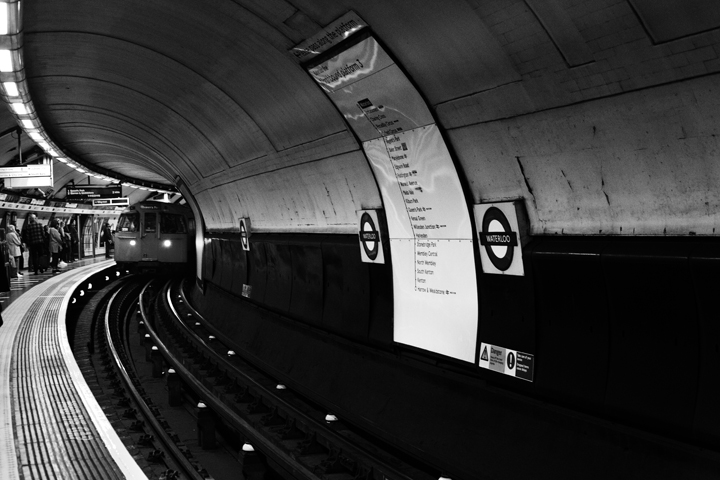
Thousands of people pouring in and out of London. Escalators, like conveyor belts, transporting people in all directions. Men, women, transgenders, children, all looking only ahead. Some carry coffee/tea mugs in one hand and Metro in the other. There is absolutely no eye contact but every person is aware of their surrounding and the presence of others as they glide, wriggle, dodge, walk past without knocking into anyone. The whole scene looks like an alien experiment designed to study human behaviour after being injected with a soul-sucking drug. We seem to be all alone together. I am dispassionately humming Abba and switching to The Kinks’ eponymous number.
A piano busker comes into my view. He is playing and singing The Long and Winding Road that echoes in the tunnel. And as if the alien drug injected in me wore off just then….I feel a stabbing pain in my heart. My soul wakes up and moistens my eyes. Tears roll down my cheeks like broken string of pearls.
McCartney wrote every single word for me it seemed as I walk past the pianist, mouthing the song as it peters out…
Many times I’ve been alone, and many times I’ve cried.
Anyway, you’ll never know the many ways I’ve tried.
Car journeys usually start at the break of dawn. London to Wiltshire was one such. Food, music, conversations, family – a potent mix of jollity. Few hours went by in a jiffy.
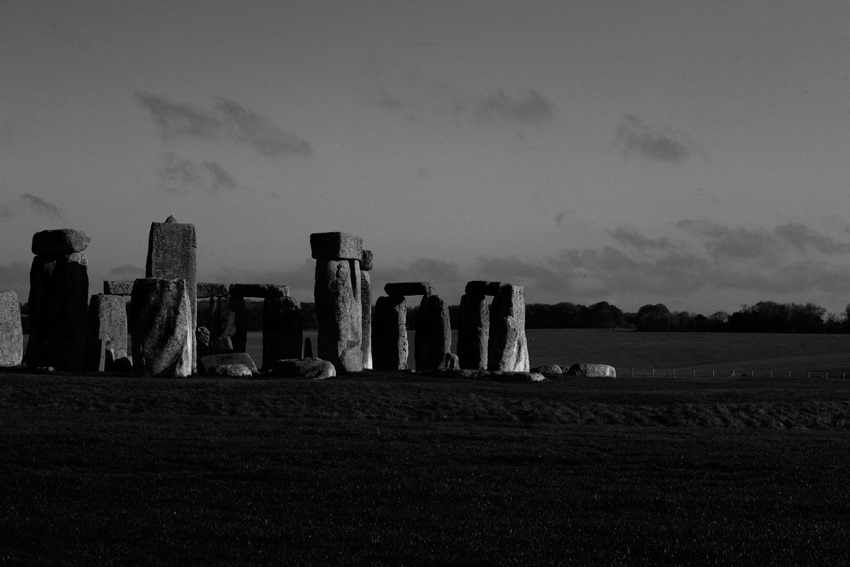
Stonehenge, a disappointment at first sight, but mesmerising on closer experience.
There is nothing instantly obvious to admire. Couple of very large stones erected in an English countryside. But you stand still for a while. Stare straight at the stones. You suddenly begin to feel them transcending their physical outfit to provide a spiritual encounter.
For thousands of years, Stonehenge has remained an enigma.
According to folklore, Merlin, wizard of the Arthurian legend, created the site with the help of giants who transported the stones from Ireland. There are some fascinating modern-day interpretations of the structure, from it being a site built by aliens, probably as their landing site, to it being a place of Druid worship. Some see the stones laid in the shape of female genitalia – as a giant symbol of fertility.
“Stonehenge” — whatever the reality, however it came into existence, wherever it came from, whoever built it – the less we can substantiate its origin, the more we will be drawn to its mysteriousness.
If stared at long enough, the spirits start to communicate. They possesses you.
I am pretty much bored of taking photos. There is no challenge around, nil creativity, internet deluged with mediocre work, everybody falsely praising everybody else, sycophantic and sugar-coated comments becoming the norm, and art critics dead.
Just when I thought I was done, I am able to envision images before shooting, and also getting the results. Oh, no, I am still far from being labelled an expert. Karma is playing a role here. Photography is not letting me go. It loves me. It misses me when I ignore it. It pushes itself in my face, in my psyche, my heart, my hands, and my dreams. It is entrapping me with fluke shots.
Last couple of days I have walked aimlessly on London streets. Like any other metropolis, this too is busy. Too busy to pause, look, or care. The anonymity it lends to individuals is sort of nice. I can sit, think for hours. It won’t impose on me its speed. I won’t be pushed or shoved if I didn’t allow. I am part of a slowly exposed still.
I stop noticing people. They are like a motion blur. My camera is restless. I spend money and time to be there. One good shot would be a bonus. I have shot almost everything on those streets. I start to create ‘odd’ images in my head, and then fire the camera. God damn it! I am starting to get exactly what I pre-see in my head. I have the camera on full manual settings, including the lens. I don’t want perfect results. I want blurs, poor compositions, over-or-under exposed shots, and other such results that will convince me enough that I am not cut out to be a photographer. It is not happening. Something out there is not letting me give up just yet. I want to travel. Have adventure. Spend my days walking and observing life, and nights in dimly-lit rooms in near silence. No camera to distract me.
It won’t happen yet. My camera is intelligent. It programmes itself to my visualisation. It is giving me the results with very little effort on my part except the part where I am being a fantasist. Canon baby is making my fantasies come true. This will last until I fall in love again. I have to pretend to ‘neglect’ it.
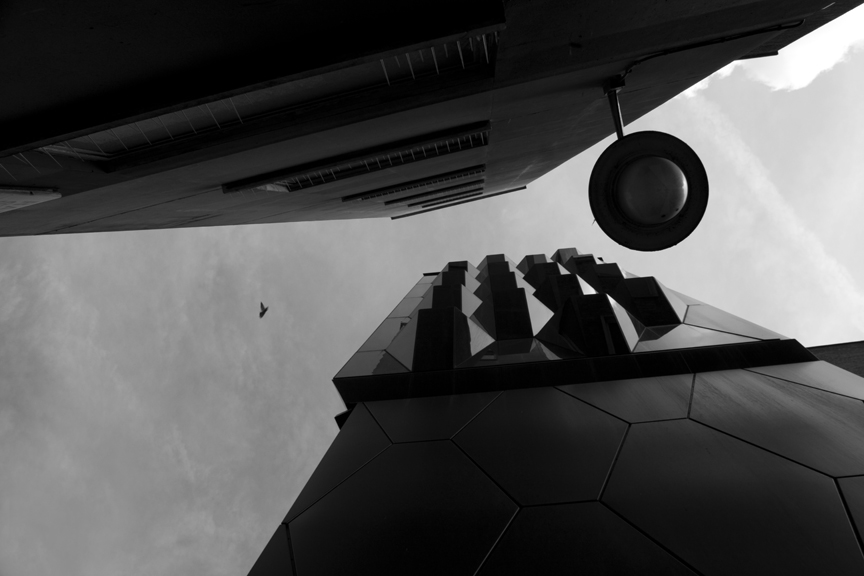
Seated on a bench, I watched the pigeon. It won’t leave my feet, hopeful for some crumbs. It then flies. I wait again. I will photograph it in flight, between those buildings, almost silhouette-y, but not entirely, as I want the lamp to have some light from underneath the white globe, and also slightly exposed buildings to give some context to the bird’s position.
Wishful thinking with an all-manual camera and an unpredictable bird.
It comes in the view, and I wait again until it is there where I want it. Will it? Maybe not! It just might!
And, it did.
One shot only. I didn’t want to do a second ‘for luck’s sake’. I wanted a ruined image. I wanted to return home frustrated, angry.
Can anyone ever get a image exactly how they imagined against such odds?
Divine intervention, perhaps.
On a separate note — I feel like the bird. Free. On my Jack Jones amidst urban chaos.