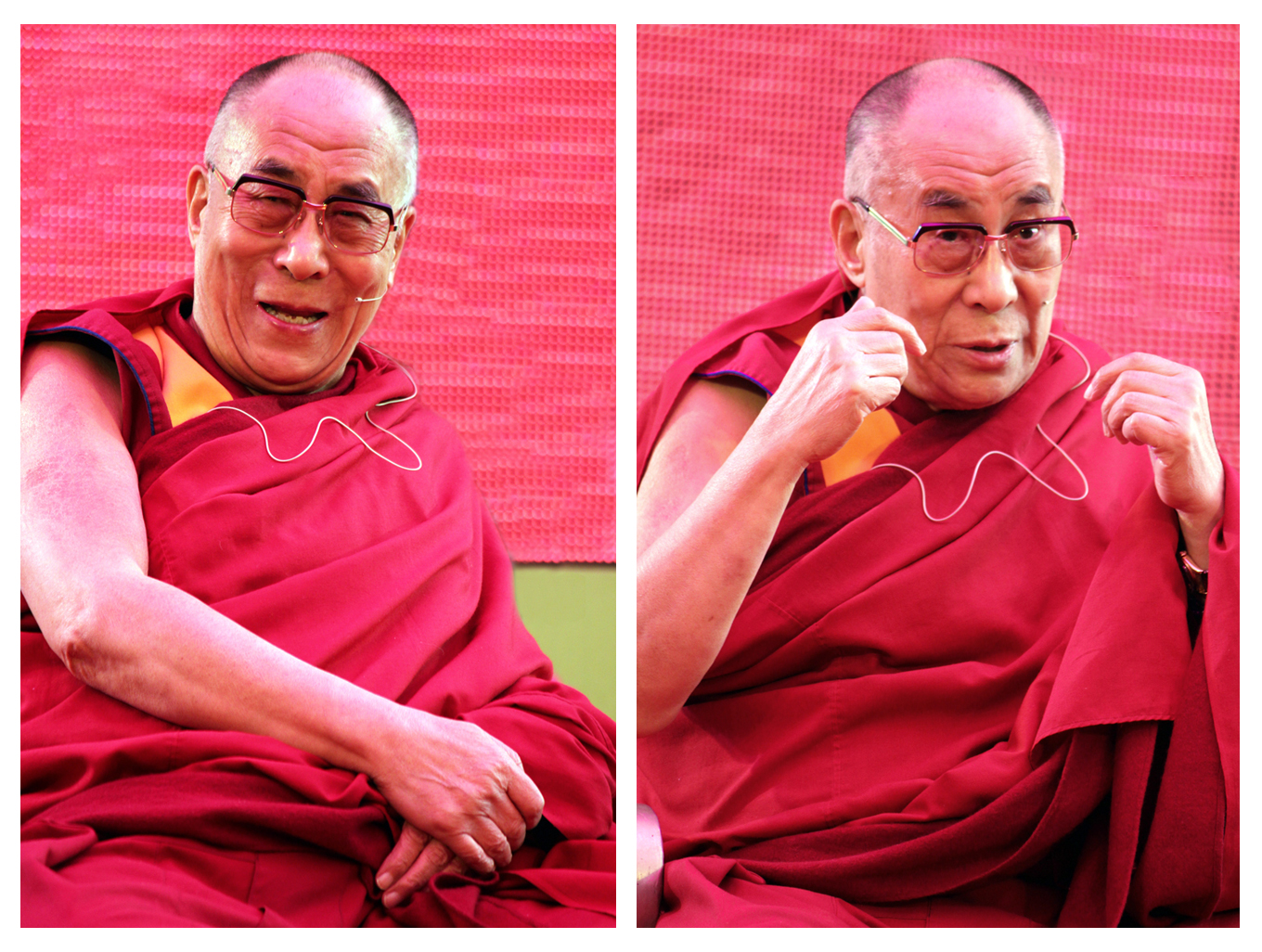
The opportunity to photograph His Holiness the 14th Dalai Lama was one I had waited all my life. I am not sure if his arrival has always been such a closely guarded secret as it was at this particular event in Rajasthan, India! People got to find out only half hour or so before about the arrival of their much-loved spiritual leader. The moment the news broke, so did the rest. The uncontainable darting, galloping, hurtling, flurry of humanity with lost sense of direction, all wanting to take position for the best view.
Having good connections within the event’s committee meant I learnt about the his arrival the night before. Landing at the venue slightly early, I glued myself to the front, slightly lower, of the stage, without giving into the the pushing and shoving, where I thought he would be seated. I wanted to photograph him up close. Full stop.
There he walked in, the humble superstar, followed by hundreds of Buddhist monks. His mesmerising presence induced a brief state of hypnosis and I forgot all about firing my camera’s shutter. Once ‘awake’, I fired a couple of shots, determined to capture his captivating and infectious laughter. He delivered, like always, in the famed Dalai-Lama-style, leaving me entranced by his charm and magnetism.
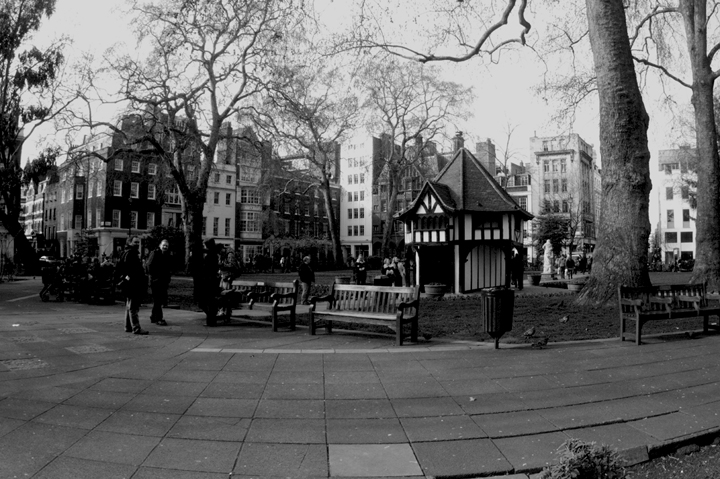
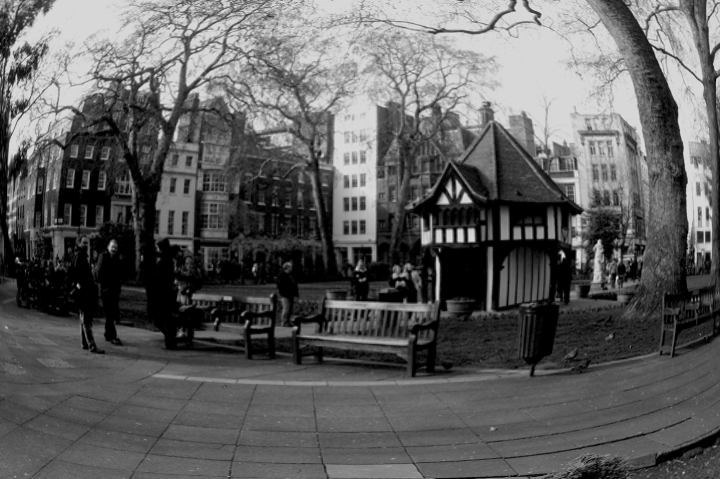
Soho Square, London. Shot with a Pentax K20D + Pentax 17 mm fisheye lens (Converted to BW, otherwise unedited) Soho Square, London. Shot with a Pentax K20D + Pentax 17 mm fisheye lens (Converted to BW + edited to create the fisheye effect )
I am now a full time Canonite but, over the years, I have tried very many different camera brands in film and digital both: Canon, Fuji, Pentax, Yashica, Minolta, Kodak, Polaroid, Hasselblad, and a few lesser known brands. Several models in each of these brands were tried by me, and each brand owned with several different lenses. At one point I worried I was becoming a collector.
Pentax made fine SLRs and supreme lenses. I had owned several of them, including a 17 mm fisheye. I had no idea when/how/why anyone would use it. For a photographer using a standard prime lens extensively, I found the fisheye too gimmicky for my needs. I was documenting life around me, and my eyes did not see the world like a fish’s eye.
Before I parted with the lens, I was curious to know how a fish would see London’s Soho Square. This shot was the result of my curiosity, but it failed to impress me. All the other fisheye photographers had splendid convexes, but mine was an image struggling to bloat from its belly. How can I present the mildly wide image to the world, I thought, and talk about the impressiveness of the lens? What was all that ado about when all it did was distort everything. and not do a good job at that either? What next? A Dogeye lens? Then a Coweye, a Pigeye, a Waspeye? Like the lens, the image never left my bag.
All this time I was familiar with the full frame equivalence and crop factor calculation, but it never struck the dense me that the 17 mm fisheye from the film days, now being used on my APS-C sensor Pentax DSLR, was not exempt from this. Don’t know why the calculations were restricted by me only to the ‘straightforward’ focal lengths! 😦
Now that I realise the reason behind the lacklustre result, I decided to recreate the image, pretending to be a fish wanting to correct the perspective. I used Photoshop to do this. Stretched, squashed, squeezed, pushed and pulled………..and voila! I ended up with this beautiful image. For a fish. Just kidding! I find it splendidly pleasing. There is so much more to absorb and admire. In short, it is akin to looking at the world from a different perspective, literally.
I regret cursing my lens and parting with it prematurely. Each time I see this picture, I imagine a gold fish with a curled lower lip, looking at me with annoyance and saying, “These humans and their obsession with the standard view!”
(The only reason some of us Pentax lovers moved away from the Pentax range of cameras was because it, sadly, delayed entering the full-frame market. Even now, their D-range DSLRs are highly underrated. In my opinion, they were capable of producing superior images that were on a par with those with the best Cannikons of the time)

 People | Life