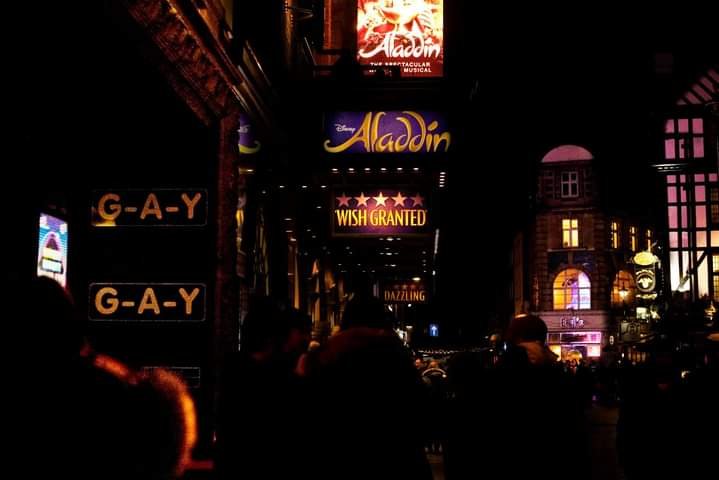
I want a rug flight, Jinni!

Over the years, I’ve photographed almost every famous street in London, but a great number of photos in my collection are of the West End where stage shows are known to run for a long time, sometimes decades. So, one might see the same theatre-billboards in my photos spanning over many years, then one day it will have changed. At Prince Edward’s, I’ve seen only three changes in 12 years, Jersey Boys to Miss Saigon, and then Aladdin. (I heard Mary Poppins is running currently, but I’ve not photographed the theatre in recent months).

Westerners (especially the young), when asked about Aladdin, claim to know who he is/was – a Disney character, obviously. They are right. He is a Disney character. But not to us Easterners.

We grew up reading Aladin ka Chirag and Aladin aur Genie, or the Forty Thieves, as part of our intra-and-extra curricula. Every household had Arabian Nights literature. In school, one year we would have essays on a portion of the One Thousand and One Nights, while another year we will spend on comprehensive study of Dickens’ David Copperfield. Even Don Quixote and Sancho Panza were sketched in our books and exhaustively analysed, down to Quixote’s horse’s hooves. It was as if reading the books was not enough, our young minds had to find the answers to all the whos, whys, whats, wheres, hows, and even whynots. I’m not even going to touch upon the topic of poetry, because if someone read my blog, they would scracely believe that we learnt every single poem by heart, as a stanza from anywhere from those 30 to 40 poems learnt each year could be asked in the exam. Literally, like this…

Q1. Write the title of the poem, the poet’s name, and complete the following stanzas…

One shade………… innocent!

Q2. Read the above poem and explain who, what, where, how, why and whynot.

(I’m pretty sure that Keats and Byron scholars made things up as they went along… to cause us frustration). (Okay, I did touch upon the topic already). And, why do people celebrate Shakespearean English that much but not speak in that?

Even so, despite the lengthy syllabus and ongoing frustration of coming up with gobbledygook explanations, English Literature and English Grammar (yes, that’s right. Grammar was a standalone topic) were my most favourite subjects, followed closely by Geography. Hindi was fairly easy too. Sanskrit was fun as we can show-off a bit, by reciting the ślokas to the non-learned. I never understood why I had to learn anything else. I suppose it was to help our kids one day with their school work. And, Maths! Where is that boy, Aryabhata? Bring him to me!! I’ll sort him out.

So, coming back to Aladdin…

I came across this photo of mine from one of the street adventures and was transported back to my younger days of The Arabian Nights nights, surrounded by many books, some with illustrations, while some without, in which case we imagined the magical scenes and the flying rugs. I had mastered the drawings of Genie and the magic lamp. I owned a similar brass lamp from Rajasthan (I’ve often compared things between Arabia and Rajasthan – desert, climate, camels, jewellery, cooking vessels, musical instruments, and also the music). Once or twice, I tried rubbing my brass lamp to summon the Genie, but a giant cockroach appeared instead from under the door, let in by my brother, who expertly disturbed my concentration. In retaliation, I would catch a lizard from the adjoining tree and let loose on him.

My room had a beautiful rug and my mind had the capacity to imagine beautiful things. I read somewhere that if I could learn the magic words in Arabic, I could make my rug fly, with me seated on it. So, I started to leave my verandah door open before uttering the magic words (in case the rug wooshed and started banging against the glass – I might have had a “crash” landing). But the rug never left the earth. It probably could not comprehend my rustic Arabic. The accent was too Hindi. I knew I had to brush-up my Arabic.

At the university, I had several Middle-Eastern friends. I tried to learn a little Arabic from them, but they were more keen to learn English from me. They did not crave the rug flight as much as I did. They probably had quite a few around-the-globe already, then hopped off on India.

One day…I’ll summon the jinni and get him to arrange a flight for me. And since I’ve waited so long, a detour would be appreciated. Moon maybe!

P. S. I never understood this… Genie is meant to be an imprisoned slave, a good guy in the Nights, then why do we in the East use the word ‘jinn’ as having negative connotation of evil, devil or unpleasant or monstrous spirit, a shaitan?

Whys for another time! For now, I’ll curl-up in bed and dream of flying and enjoying a bird’s-eye view of the planet. It’s an interesting way to put all things into perspective. My little worries won’t mean much from above. I’ll be just a speck, and my worries even smaller. Thank you, Aurelius.

… Sapna Dhandh Sharma
Ghoongat – Statement of Sexiness

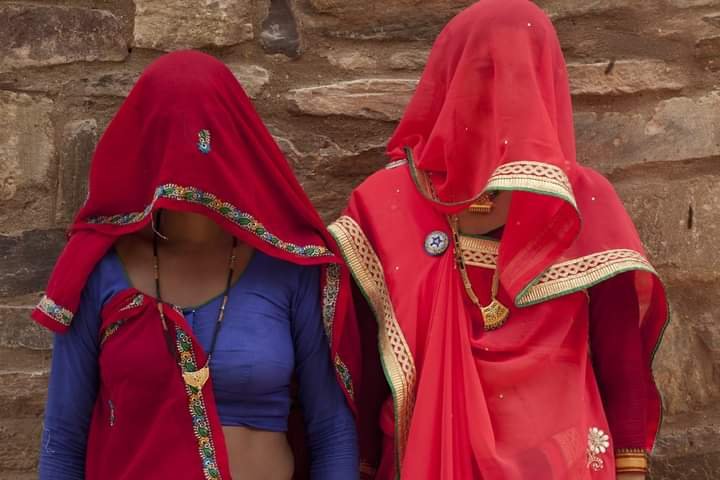
Seeing women walk the streets with their heads covered with a brightly – coloured sari pallo is a sight I’m ever so used to. And yet, I was sold into the fuss of the hijab in the West until a friend noticed my photos from Rajasthan and enquired whether Rajasthani women wore veils too, like the Muslims. Veils? Of course, that’s what it looks like! That’s when it struck me how Westerners, who are not familiar with the Eastern customs, perceive a ghoongat.

Ghoongat ‘is’ a veil, but not a hijab. Ghoongat is worn only to cover the face in front of family male elders, or elderly visitors, but not strangers. Head is incidentally covered as there is no other way to bring the sari on the face. (Head-covering is a custom many religions around the world observe during religious practices, and hence not unique to Hindus)

Coming back to the ghoongat, it is not as long or as dark-coloured as a hijab or burkha; it is mostly made from a colourful semi-transparent material; and only reaches either below the nose, exposing the lower face (lips, chin and neck), or barely below the face, leaving the neck exposed, while the face is faintly visible too through the chiffony material. Funnily, some women who wear the ghoongat have their cleavages or bosoms revealed with no sari draped over the blouse, making the subject far more conspicuous instead of doing the opposite. I personally think it’s a statement of sexiness. 

When I photographed these women, my foreign-born sister-in-law was with me, and curious to know why one lady was more covered than the other. I knew the answer instantly – the older woman, with less covering, exposed bust, was the mother-in-law of the newly-wed younger one who was fully convered out of respect for the elders in the community who were around when we met them. My sister-in-law responded, “It’s totally the wrong way around. Younger woman should reveal more, while the older should remain covered.” 😂 Made complete sense. But the young one was preserved, so to speak, for her new husband.

Well, on old or on young, the ghoongat covers much less than it reveals. A ghoongat might be a veil as a hijab is, but the distinction between the two remains stark. 

In a separate discussion on cultural nuances….

There was an incident in the US where a female employee of Indian origin walked into her corporate office wearing a sari, but was asked by the employer to not repeat that attire in the office as it reveals too much flesh (waist, back, neck and arms) and deemed “overly sexy” (the word ‘sexy’ was actually used). Strange, because in India we consider sari a conservative piece of clothing, while a skirt not so much, as it reveals legs. In some cultures, it’s okay to wear work suits that keep your legs uncovered, but wearing clothes that reveal the upper body flesh would be considered inappropriate. On the other hand in India, a country that’s labelled conservative (by western standards), though the legs remain mostly covered (not prohibited, thankfully), flaunting of cleavage and waist is permitted, because that’s exactly what a sari does, and yet it’s considered a conservative attire and broadly worn by professional women. Ah, so fascinating to observe these cultural differences; and difference in understanding and perspectives.

The Day I Met The Gurjars

Over the years, and even before I declared myself a photographer, I photographed several towns, districts, tribes, people and their homes running along and across the Aravalli mountains. I’ve been driven along the fold mountains ever since I was born, either to reach our ancestral home, or that of our relatives, and now my parents’ and brother’s. In recent years, my brother, Deepak, has driven me around hundreds of miles, through villages and tribal areas that made for a fascinating experience. Because of his extensive travel experience and knowledge of the areas and communities, he’s fully familiar with the places I will find interesting, as a photographer. His good connections in the land have proven useful too, to get access to no-go zones. People who would normally not entertain you, happily welcome you, because there is a common language and understanding once we have had a chance to connect.

This day was one such experience. We drove far from Jaipur and reached a town habited by the Gurjars (aka Gujjars). There was a tense environment upon approach. Gurjars have been, until recently, a lot in the news because of rioting, killings, disruption. They are a feared tribe of the North. Their men are tall, physically strong, fierce and rough in approach, proud but with a patriarchal mindset. They are known for charging before speaking. They own swords and carry knives hidden in their clothing. That’s what I’m told. Basically speaking, you cannot afford to be a gurjar’s enemy in those regions. I sort of worried thinking what might happen. They had rioted on the highway only a few days before we went there.

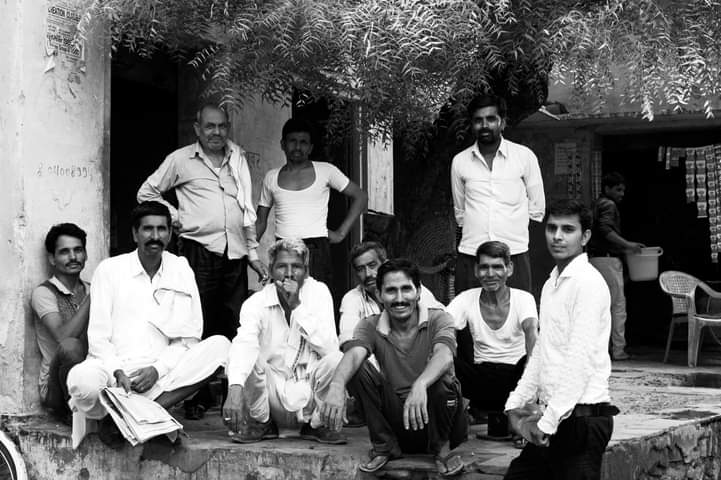
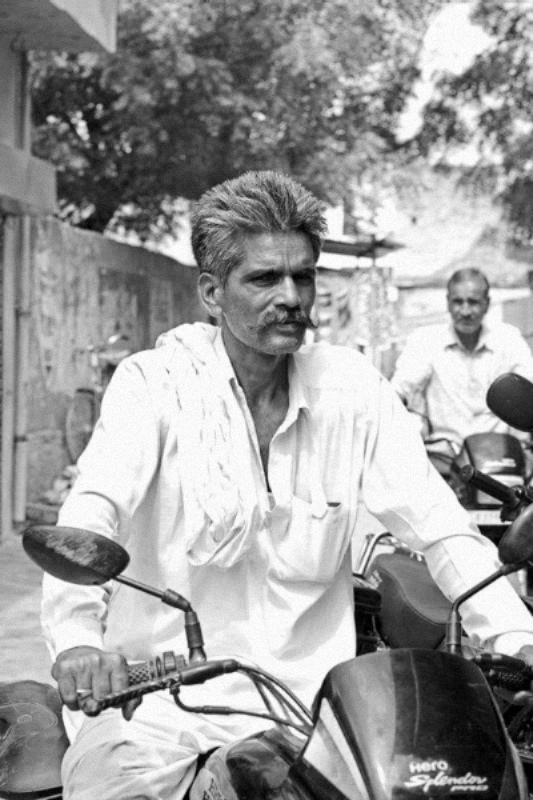
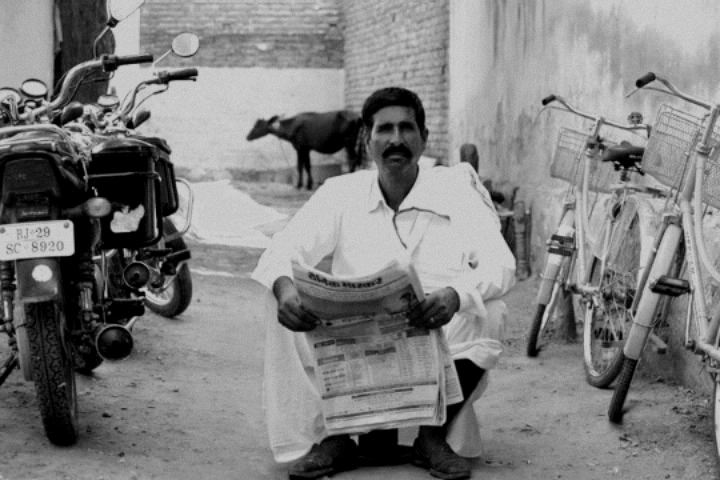
So, here we were, myself and Deepak, entering this village. We got off at the square where many heavy-built men with sun-kissed ruggedness and long moustaches were seated on their Enfields and Hero Hondas, or on a raised chabutara. Two of them got up with their sticks to enquire the purpose of our visit. Deepak got out of the car to speak to them. After a few minutes, he returned and asked me to step out of the car and enter the village. “No holds barred. You have a free rein,” he says. That I can do what I like, enter any home I like, speak to any man, woman, child, elderly, take photos of their homes, people and cattle. This came as a blessing for me.

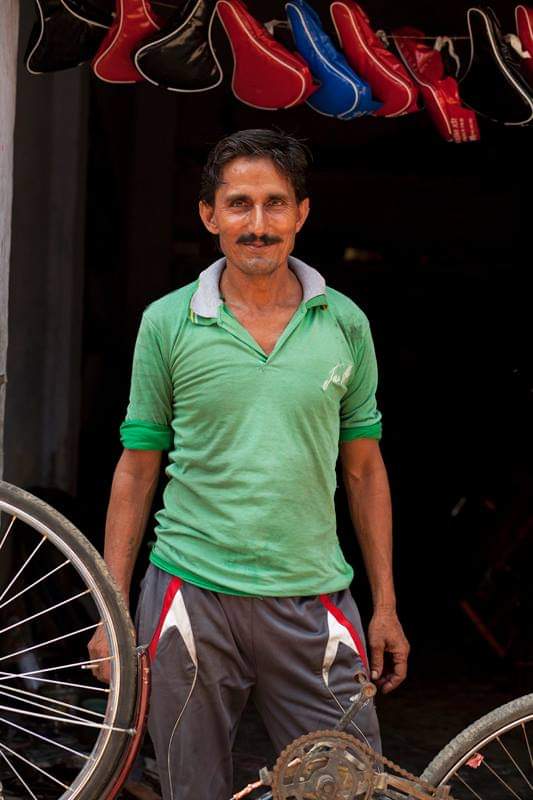
They did, though, kept asking in various ways if I was a journalist. It took me three hours to convince them fully that I was one of them, a Rajasthani, and not there to cause any trouble. That the photographs were for personal use, not commissioned by any publication, that what they share with me will remain with me. No one will find out. I had no qualms about sharing my details with them, just to put their minds at rest. I spent the day chatting with and photographing the tough guys as Deepak patiently waited at the square with the even tougher ones. One sweet young fellow in green, with green eyes too, invited me to his cycle shop. If he’d ever walked on London or LA streets, people would have mistaken him for Kirk Douglas. By god, that resemblance was uncanny.

The toughest nut to crack was the head of the Gurjars. The old man, who Deepak addressed as tau. They had met a few times before, as Deepak had passed through the town a number of times, but never had he sought permission to allow a stranger (me) into their lives. It was the first. Once cracked, tau took me to a few homes himself. Nobody could turn him away. That’s the kind of authority he wielded among the village folk. Deepak waved at me and said, “Now that he’s happy with you, you are set.” I was actually set. That’s when I got to mingle with the toughest lot. The stories they shared will remain with me forever. They got their women to offer us tea and snacks. They preferred I didn’t share photos of their women, but allowed me to photograph them. I appreciate and respect their trust in me.

It was the most gratifying journey, thanks to Deepak who made it all possible for me. Thanks to the Gurjars who welcomed me in their homes and lives, shared stories that changed my perception of them. People might continue to fear them, but they promised me that I can visit anytime I like, give any one of them a call, and they will be there to welcome me.

….. Sapna Dhandh-Sharma

Langurs of Amer

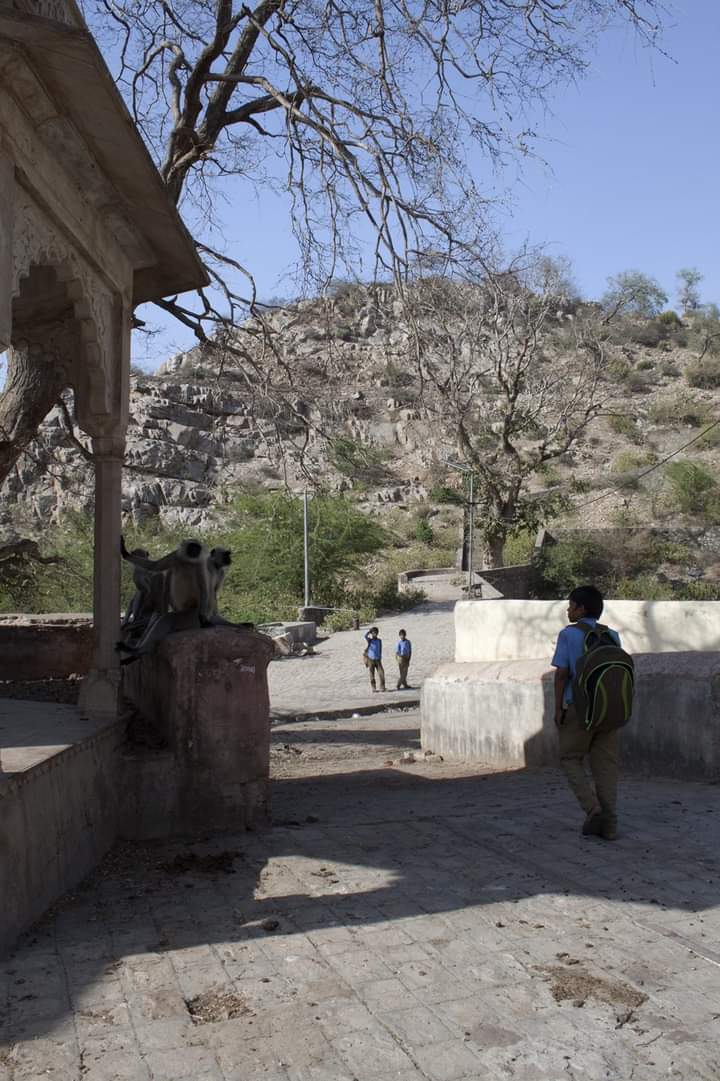
It’s rare not to find a langur army in and around Jaipur fortresses, palaces, lakes and Aravalli foothills.

This photo was taken on a hot summer day. A hot summer day in the desert state is not the kind of heat most people are accustomed to elsewhere. Those who are not accustomed to such temperatures should not venture out here during daytime.

A school bell (the old school bell, literally) had just rung and the school kids carrying huge backpacks poured out in their hundreds, but quickly dispersed. Many, forming small groups, went towards the hillock, climbed the snaky rugged path before disappearing into a distance. I had no idea where their homes were, but I could only guess they must be behind that mound. When seen carefully in the photo, one can see some kids walking in a distance on the hillock.

Although, I’ve studied in India, and am used to the concept of carrying huge school satchel bags (as we didn’t have backpacks in those days, only traditional satchel bags), but I’m increasingly noticing the weight Indian kids carry to school and back daily. Why do such small kids need so many books everyday? Well, I kind of understand as we needed them too, but I can’t help but feel sorry for the kids.

The nice thing for these kids was the company of langurs on their way. A daily ritual for them, but they seemed to still enjoy as much as I did. I stood there for some time to observe how they took turns to run past the monkeys. Black-faced langurs are not known to be dangerous. They are only disruptive, especially when they enter homes. They can open your fridge, grab what they want, eat, drop, make a mess, eat your plants in the garden, break things before they exit.

But these kids still exercised caution. The kids who managed to cross first will wait for the rest of the group members to join. The funniest thing I noticed was how the ones who made it to the other side would shout and cheer the remaining ones, “Come on, you’re brave, langur won’t do anything. Hanumanji hain! (he’s only Lord Hanuman – meaning “Gods don’t harm”). Such words of encouragement. Emboldened, they all make it past the monkeys.

They will do the same thing all over again tomorrow. The monkeys will again wait to grunt at the kids. To scare them. It must be a kind of game they all play together. I think they understand each other well. Thinking this, I exit too, without leaving a mess though.

…. Sapna Dhandh-Sharma

Who resides over Lord Vishnu when, allegorically, no one can?

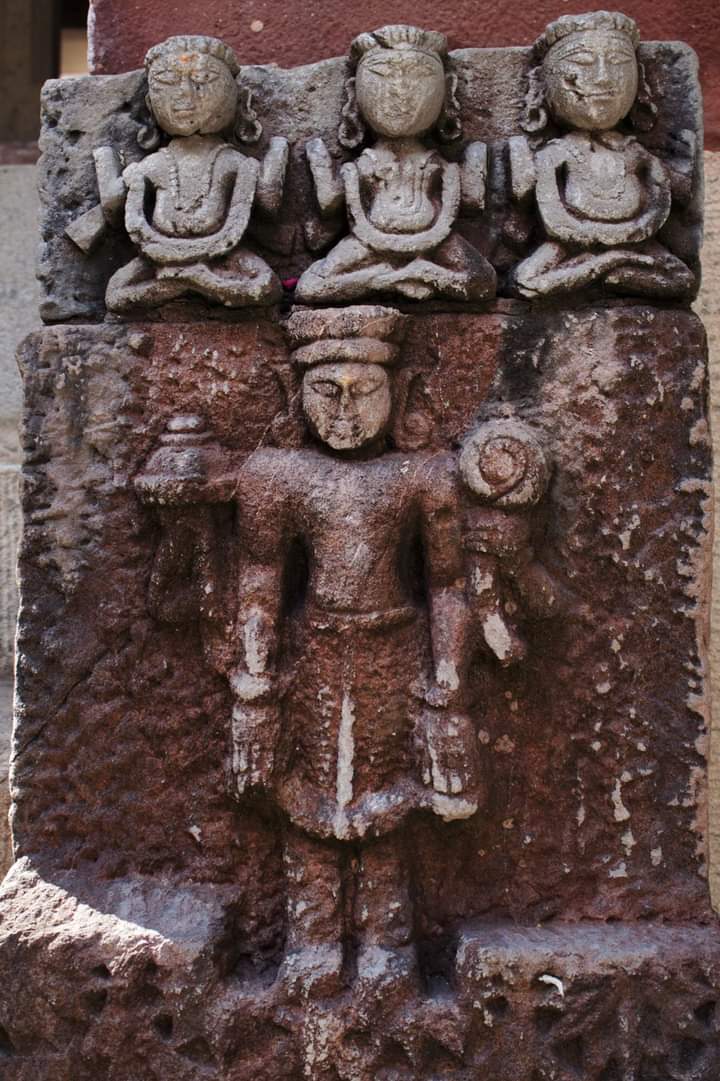
Lord Vishnu

This stone statue was in a small 500-year old temple in Amer. I first thought that the three seated on top formed the trimurti, the Hindu trinity.  Upon close inspection I realised that the main standing statue is of Lord Vishnu, who happens to be one of the three supreme gods of the trimurti. And those seated above Vishnu cannot be identified as the trimurti. They are dressed more like sages than like Gods, who are figures of ostentation, except for Lord Shiva, who appears handsomely powerful even when seated half-naked. And his hair is beautifully top-knotted with Ganga flowing out of his curly hair-locks. He would never sit docile like a sage. And then, these are three.

So, who are they? Could one of them be Narad muni? But he originates from Vishnu’s navel. Let’s say the connecting piece fell off during the move. What about the other two figures then?

Or are they not even part of the main statue? Two separate stone carvings placed together, like in most places where ancient temples and palaces are in a state of disrepair and neglect, and stones weathering at different rates.

Could this explain the difference in colour of these two pieces?

Whatever maybe the case, it’s a beautiful piece that’s survived half a millennium, and probably would last another half.

… Sapna Dhandh-Sharma

Cocktail in New York. Pheras in Paris.

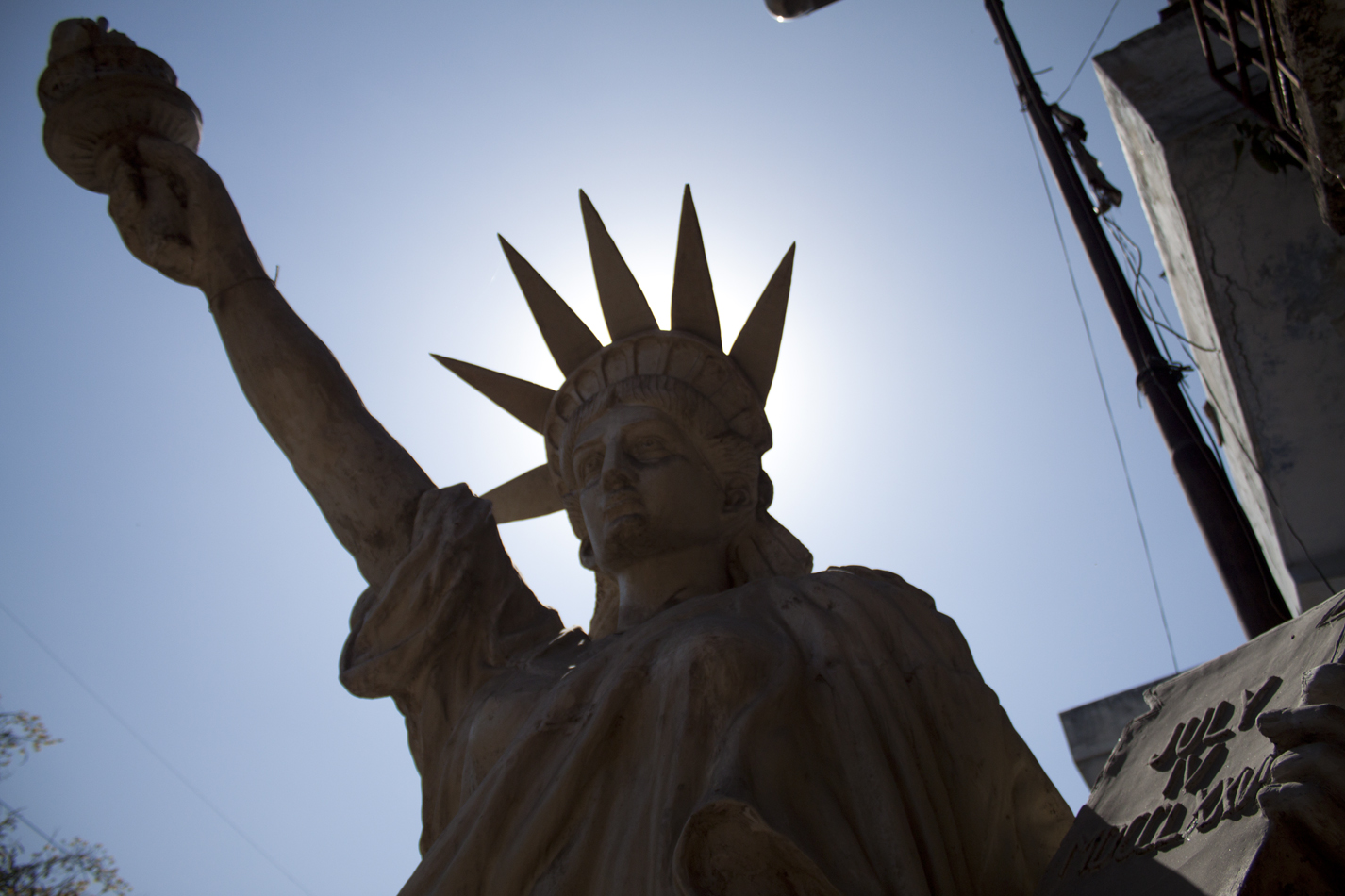
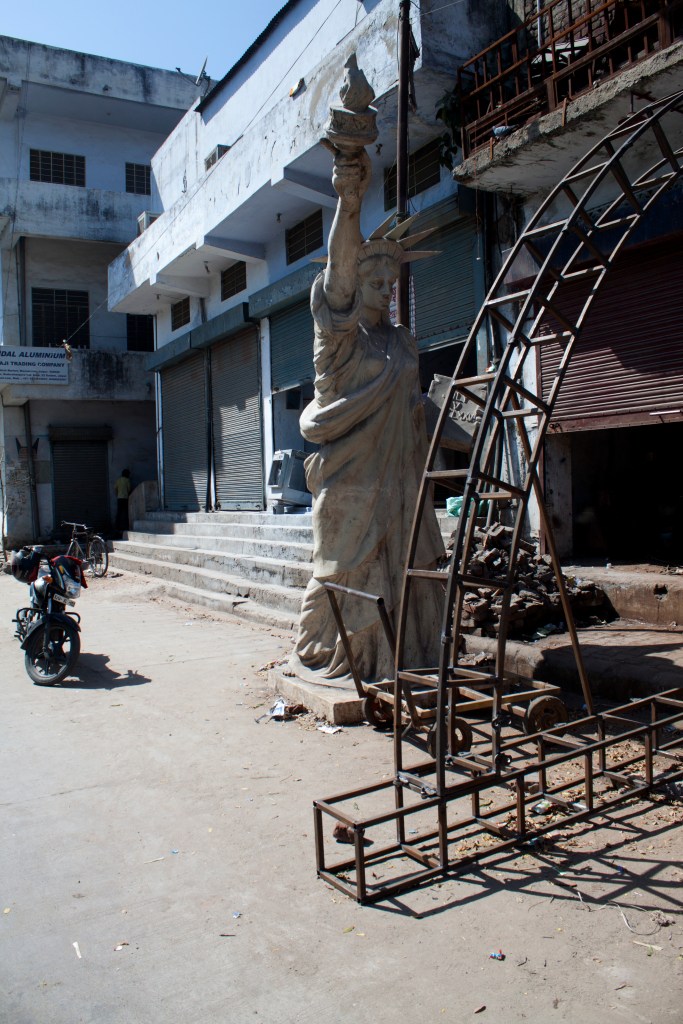
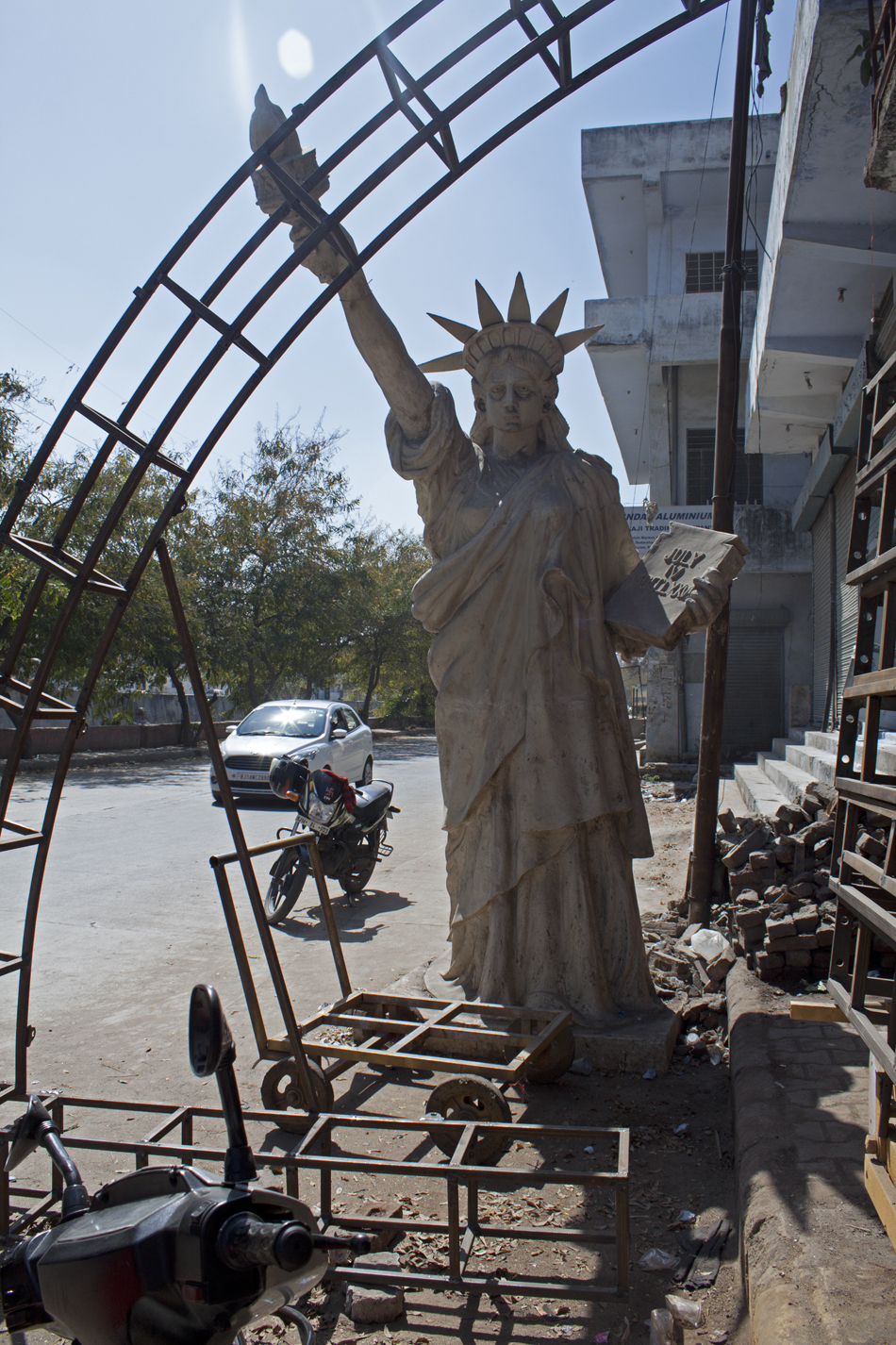
My family and myself were in a car driving through the lesser known streets of Jaipur. There were shops alongside residential areas — greengrocers, motorcycle repairers, barbers, stationers, street vendors, metalsmiths and stonemasons. Building smaller replicas of famous statues and other landmarks seemed to be the side business of the metalsmiths and stonemasons combined, as I saw quite a few statues scattered, part finished, part unsculpted.

Libertas, that attracted millions of visitors daily in the West, had almost zero admirers on that street. She stood on a shoddy unpaved muddy sidewalk in 48°C (118.4°F).

We were instantly amused, but also bemused. What was that statue doing there? There was clearly a demand for these. In the habit of always carrying my camera, I got off the car to take a couple of photographs. The men on the site found my actions as hilarious as I found theirs.

I asked where the statue was going. “It’s for a wedding.” It saddened me to learn that these men on meagre wages were building these enormous figures for an evening party. “What pleasure exactly could be derived from these cheap replicas that cost many times more than those workers’ combined monthly wages?” I wondered. “Were they trying to fake the location through these?” “Were the business families uploading the party videos on YouTube, captioned, ‘Cocktail in New York’?”

What next? A demolition party? Where do these statues go? Submerged into the waters like Kali and Ganesha? But this is the desert state – so, no sea. Recycled? Maybe! There might just be a second-hand market for these for smaller budget weddings. Who knows!

I never found out.

Later that evening, just when my camera packed up (probably due to the heat), I saw an Eiffel Tower in the middle of a garden in an affluent residential area. The bungalow was getting ready for a wedding (one can tell of the nature of the event from the extent of the embellishments). That was definitely a wedding.

I bet there is a YouTube video of the pheras in Paris.

In my next trip, I would like to know of the fate of these non-permanent structures.

What Does Being A Hindu Mean?

Svástika – A divine and spiritual symbol in Hindusim

I am born into a Hindu Brahmin family in India. This statement alone equals to passport to respect, social privileges, and positive discrimination for life. Every single application form asks for your caste and I wrote ‘Brahmin’, unbeknownst to me at the time its importance in terms of being accepted in whatever it was I was wanting to choose as long as I had the right credentials.

So, why in the world would I even want to highlight the wrongs of the millennia-old system, – ‘The Caste System of India’?

The answer is – my conscience does not allow me to continue without questioning.

This world; its system, environment and abundance should also belong to someone else as much as they do to me.

Same as I am opposed to monarchy, which represents all that meritocracy does not, I am vocal about casteism as this too advocates the by-birth rights, undermining the efforts and struggles of those from the ever-growing educated class, some of whom were not born into the upper strata of the caste hierarchy, but qualify only through the constitutional concessions, in spite of having the right credentials. Funnily, this new breed became a target of mockery – ‘educational success because of concessions’.

How can an upper caste person’s access to privileges not be labelled as a concession instead of a prerogative?

So, in some way, both sides of the caste-scale fall under constitutional concessions. One side has all set. The other, not so. If the caste-scale transformed into a caste-balance, it will tip to one side. The more the weight of privileges, the lighter it becomes. Oppositely, the burden of inequality is heavier, which means those on that side will forever struggle to tip the balance in their favour.

Will it ever happen? I doubt it would in my lifetime, for there is a life beyond the educational system. The upper-caste mafia rules the roost in every region, department, field, discipline, branch, sector, and so on. For some have-nots, it is a grim situation of one-step-forward-and-two-step-backwards.

Social inequality is rife worldwide. India, on the other hand, has it etched in its institution of caste. India’s caste system dates back thousands of years. It is much debated, argued and, in recent years, even denied, especially by the “modern” Indians. Constitutionally, caste-based discrimination is abolished, but socially, it is practised as openly, and somewhat shamelessly, as it always has been and reflects a different reality to the radical statement of the modern-day Indian youth.

Having said that, in my experience, the caste-based discrimination among Indians living in the West is far greater than those living in India’s urban settings. The migrators who left the subcontinent decades ago held onto the ancient and un-progressive order they were born into like an infant onto its mother’s bosom. In many cases, minimal to none social integration, or interaction with the indigenous population meant further isolation from the progressive mindset, one which India’s youth wholeheartedly adopted and want to perpetuate. The mindset I gradually started to embrace by mentally shedding the upper caste skin. I don’t remember having interactions around religon or caste. I mildly lived that life in my home, around family who had their own cultural beliefs, but without being imposed upon. We had discussions in the house, but never foisting of ideologies. A pleasantly secular household. I had freedom to make choices in life. I was like a pampered child who was left loose in a sweet shop. Perhaps, that was partly the reason I felt ill-prepared for a world beyond my childhood, a world where freedom was not considered a birth-right.

My friends were from all faiths, castes and genders. There was no fear about anything in my life that was being shaped in the same pre-dominantly Hindu and casteist society. We discussed everything under the sky, except our differences. For a girl like me, stepping into the Indian life of Britain was like stepping into a world I did not grow up knowing. Even my parents did not grow up knowing that world. This might have been a world somewhat before theirs.

British Indian society, I felt, was a sort of strange concoction of desi and fringed native, an impotent east-west cocktail with illogical, uncompromising values at its core. The elders were unwilling to adapt, leaving their offsprings in a state of utter confusion. The result was sheer misery for many. Casteism, plus racism, combined with ever-present misogynistic attitude and double standards. This is not to say that Indians in India do not have these, but they can be excused for not having lived in the West where there is far greater equality. How can one enjoy the freedom that western life offers, but be unwilling to relinquish the life alien to the free world?

Some elders go as far as making their kids feel guilty by loudly reminiscing their own marriages to their uncles’ and aunts’ family relations, skipping one gotra, as they say. If kids had any sense, or freedom to that sense, they would argue back by calling it ‘marrying a second cousin’. So, the elders not only want their children to marry in the same caste, but in the same family too, if they can help it. Familyism?

Intercaste interactions will, despite the brainwashing and emotional blackmailing, occur. They have been happening for centuries. But, somehow, such interactions seem less in a familial situation than in the realms of matrimony or out-of-family friendships. Marrying outside the caste is still seen as an unacceptable, and somewhat shameful, act. One elder actually told me that her entire family had to relocate to another city, cutting off all the neighbourhood ties, because the daughter brought shame on the family by marrying a, what she described as, a lower caste man. This elder would never mention her daughter’s married surname to people because of the shame factor.

This is another thing… In Indian families, even if you leave the caste, the caste doesn’t leave you. It’s attached in the form of your surname. This whole ‘shame’ concept is simply incomprehensible to me, especially when families living in England engage in this kind of nonsense, but I also know that it’s a culturally inherent trait that has to be dealt at grass-roots level. It is almost like no one wants to steer the boat that faces the tide.

Each caste is happily or unhappily a part of this very complex network of occupational inter-dependence. This is a chain where every unit plays a designated role. You break that link, the whole network is affected. So, when the modern youth starts uttering liberal platitudes, he has to think about which section of the matrix he should first snap in order for the system to respond positively to bring about the much-required change.

What remains to be seen is how long can a system, which took thousands of years to evolve and perfect to this degree of inter-exploitation, be changed within the lifetime of any of those alive!

Will that change be internal, or will it only be a superficial victory?

….Sapna Dhandh-Sharma

Because it’s there!

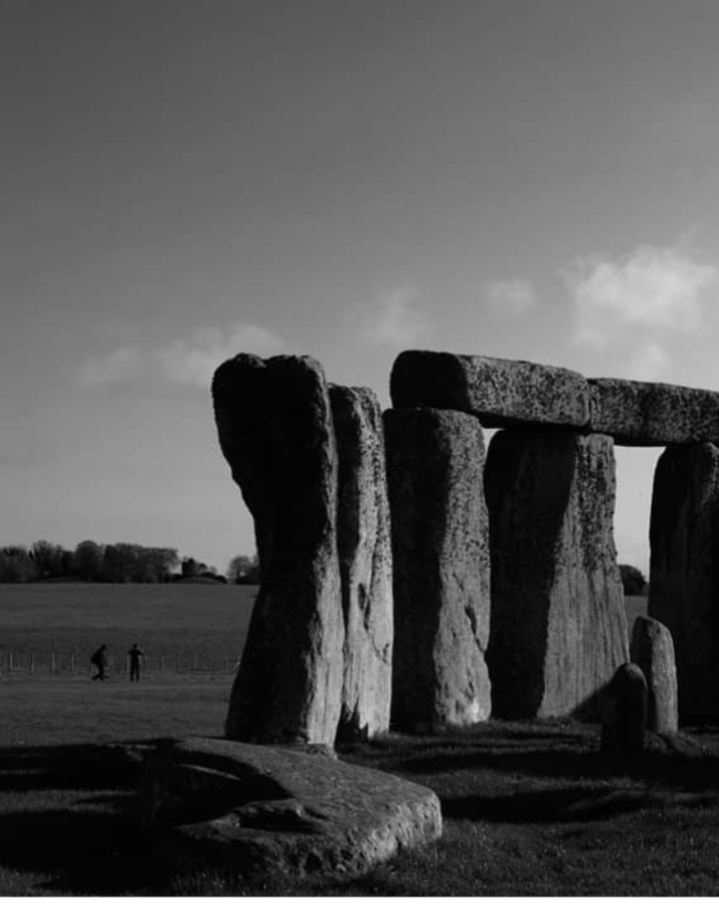
Stonehenge| Wiltshire | England

There has been a sad shift from art being created to it being questioned. The photographs were meant to be created as visual delights. A new process, technique, or aesthetic appeal. Words were for writers as they didn’t paint. They explained in thousand words what a photographer could in one frame. 

Then came the period of mass-manufacturing of cameras and photographers – the wave of ‘every person is a photographer’. 

They were. 

Are.

So if everyone is photographing the Stonehenge, then someone who is making a big deal out of photography will now need to concoct some cock-and-bull to somehow convince the world that only their photograph of the monument is worth hanging on the museum and living room walls over the millions of other photographers’ images of the same scene.

That’s all it takes.

People are attracted to the poorly lit/composed image because they are made to believe it’s created that way on purpose, for a reason. It’s deliberately pixelated, and not because the amateur forgot to adjust the camera settings…. The Mosaicy Feel – first ever. Even a bad day of photography got sold.

This not only compromises the effort of a real genius, but also encourages mediocrity as those who shout the loudest get heard, get sold. Mediocrity rules. 

Though, a few geniuses have learnt to shout too. The professionals are having to adapt. 

If my photographs are good enough, then why am I not considered close enough? How did Capa get away with it then?

I’m far from being a genius, but also far from being a mediocre. So, if an image I create evokes awe, then why do I need to explain it? 

Should my answer to why something was photographed be not as straightforward as Mallory’s reason for wanting to summit Mount Everest? 

“Because it’s there”?!

…..Sapna Dhandh-Sharma

Dalai Lama, The Ultimate Show-stopper

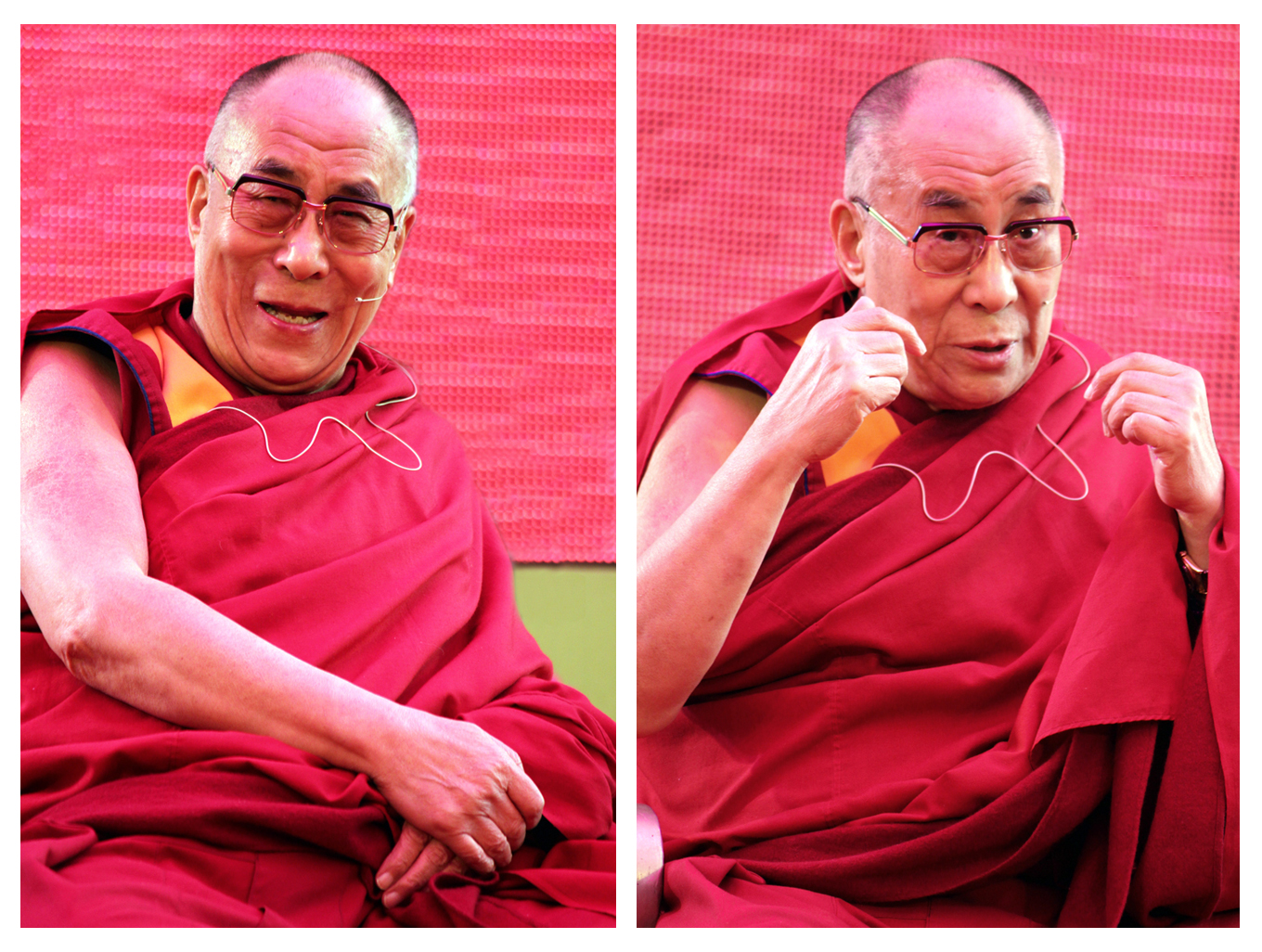
His Holiness the 14th Dalai Lama

The opportunity to photograph His Holiness the 14th Dalai Lama was one I had waited all my life. I am not sure if his arrival has always been such a closely guarded secret as it was at this particular event in Rajasthan, India! People got to find out only half hour or so before about the arrival of their much-loved spiritual leader. The moment the news broke, so did the rest. The uncontainable darting, galloping, hurtling, flurry of humanity with lost sense of direction, all wanting to take position for the best view.

Having good connections within the event’s committee meant I learnt about the his arrival the night before. Landing at the venue slightly early, I glued myself to the front, slightly lower, of the stage, without giving into the the pushing and shoving, where I thought he would be seated. I wanted to photograph him up close. Full stop.

There he walked in, the humble superstar, followed by hundreds of Buddhist monks. His mesmerising presence induced a brief state of hypnosis and I forgot all about firing my camera’s shutter. Once ‘awake’, I fired a couple of shots, determined to capture his captivating and infectious laughter. He delivered, like always, in the famed Dalai-Lama-style, leaving me entranced by his charm and magnetism.